
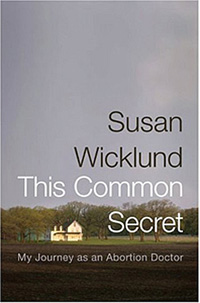
This Common Secret: My Journey as an Abortion Doctor
This Common Secret: My Journey as an Abortion Doctor
by Dr. Susan Wicklund is available at bookstores, and at amazon.com,
where it is currently the #1 selling book on Abortion & Birth
Control. The following is an interview with Dr. Susan Wicklund by Debra
Sweet for Revolution newspaper. A shortened version appears in the print edition.
 Q: How did you come to write this book?
Dr. Susan Wicklund:
As most things happen in my life, it was partly by accident, and
largely by chance that I”ve had the opportunity to write this book.
When I first started providing abortions, I was real quiet, not talking
about what I was involved in. Through circumstances, I found that the
more I spoke out, the more I felt supported and protected. I had just
opened a clinic in Bozeman, Montana, and because I was harassed by
protesters, and they broke into my apartment, I ended up renting a room
in the home of a writer, Alan Kesselheim.
And then life went on. I kept
working in the clinics and over the years had a number of things happen
that made me feel I wanted to pursue the book again. Al was also
feeling like the time was right, so we decided to hit it hard and fast.
This time I did a lot of the writing, as I needed to reveal more of
myself. I needed to talk about my own experiences as a woman, a mother,
a daughter, and a doctor. The book weaves my life into the lives of my
patients. We still didn’t know if we would be able to sell it, but it
was like this train that once I jumped on I couldn’t stop. And I’m
really happy with it.
I”d always kept
a journal of patient stories, my emotional response to the work I was
doing, the frustrations and the good parts. When I was living with Al
and his family, I”d talk about some of the stories. Obviously I was
careful about patient confidentiality, but I”d talk about the
protesters, and what happened with the patients. He”d see me leave the
house in a bulletproof vest, with a security guard. He became adamant
that I had to get some of these things written down. I had them in a
journal, but not in an organized way. He offered to help and, being a
writer, he would write things as I talked. He would work with it, and
then I would, and we ended up with a collection of patient stories,
with nothing about me personally. We had some very strong interest from
publishers. That was the time, however, when some of the more violent
protesters started shooting and killing abortion doctors, and I felt
very vulnerable and scared. So we put it away, literally, for years,
and didn’t talk about it.
Q: Why was it important for you to write it?
Dr. Susan Wicklund:
There is so much silence around this issue. We talk about it in the
global and legal sense, and talk about the laws, but we”re not talking
about the individual women. That silence has been hurting women and the
pro-choice movement in this country. At least 40% of the women in this
country have an abortion at some time in their life. It’s not something
that’s rare. It’s very, very common, but unfortunately, as the title
implies, it’s a common secret. My hope is that this book will open a
dialogue between women individually, in neighborhoods, in
organizations, where we talk about who we are in having abortions. We
should not be ashamed, or be hiding this aspect of our healthcare.
Q:
You begin the book with a story of an abortion in your own family, kept
secret for many decades. Why don’t women tell their abortion stories?
Dr. Susan Wicklund:
In my grandmother’s time, it was illegal. The young girl that was
pregnant, and that my grandmother helped, died. It would have been kept
secret even if there hadn’t been a death involved. Obviously, when you
know someone is pregnant, you know they are having sex. Depending on
the woman’s age and marital status, she may be ostracized for that
alone. Yet this is such a sexual culture. Every billboard and
commercial is sexual. There is a religious right in this country who
says you can only have sex to procreate. Whether we buy into that or
not, there still seems to be something shameful about that part of our
lives. An abortion says that not only was the woman having sex, she was
probably having it just for the pleasure, not for procreation.
Q:
Abortion was a crime through most of the 20th century. We”ve gone
through 35 years now since abortion has been legal in this country, at
least in the first three months of pregnancy. When abortion first
became legal, there was a great feeling of relief among women that you
didn’t have to carry a pregnancy you didn’t want. You didn’t
have to risk an illegal, dangerous “back alley” abortion. But, once
abortion became legal, it was part of the capitalist health care
system, where every social relation between people is a commodity
relationship.
Dr. Susan Wicklund: I”ve
watched that in the 20 years I”ve been doing abortions. First of all,
when Roe v. Wade first came about in 1973, many of the people who
immediately started providing abortions were women. You had feminist
women’s health clinics. A lot of the people were doing it because they
thought women should have safe, legal abortions. The women managing and
owning the clinics were not necessarily physicians, but nurses or
social workers who had seen the impact of women having abortions when
it was still illegal. They knew what it meant to have abortion be
legal, and so they opened up clinics across the country that provided
services in a non-profit, feminist setting. Now, like most medicine,
it’s become a managed-care situation where the people owning and
managing the clinics, and sometimes even providing the abortions don’t
remember what it was like when abortion wasn’t legal. They are looking
at it as a business instead of a service to women. The type of care
that women are receiving has changed in many places. I find that very
disturbing.
Q: How do the state laws restricting abortion affect women?
Dr. Susan Wicklund:
They are intimidating to women, and, in my opinion, cause an undue
burden on women. Roe v. Wade said state laws regulating abortion could
not cause an undue burden. The Supreme Court looked at these laws and
decided they don’t cause an undue burden. But what I see on a daily
basis is that these laws do cause a burden.
Imagine being
a minor and for some reason you are unable to talk freely with your
parents about the situation. In many states, you must appear in court
and talk with a judge to get his/her permission to have the abortion.
And in many states, a woman is mandated to hear medically inaccurate
information before having an abortion. This is information written by
non-medical people whose main objective is to stop abortions. How could
this not be considered an undue burden?
We”ve gone significantly backwards since I started doing abortions 20 years ago. 89% of counties in the U.S. have no
abortion provider, up from 82% several years ago. In a big part of the
country where the population is largely rural, abortion providers are
very spread out. For the clinics it means providers have to be brought
in, since local doctors don’t want to be involved, fearing an effect on
their local practices. This is an added cost and difficult in terms of
time, etc. In many states, it’s not unusual for patients to have to
travel hundreds of miles to obtain an abortion. There’s no clinic in
Wyoming, a handful in all of Montana, one in South Dakota, one in North
Dakota. It’s difficult to find services or even accurate information
and referrals if you live in rural areas. And where will the patient go
for follow-up care if there is no physician in her hometown she can
trust?
Many hospitals in the U.S. have been bought by
religious organizations; in some parts of the country there are no
hospitals that will do abortions because of their religious
considerations. Less than 10% of all abortions are done in actual
hospitals, all the rest are done in physician offices or freestanding
clinics.
Q: What happens to a woman because of the 24-hour waiting period?
Dr. Susan Wicklund:
There’s no way to get around it; you comply or you don’t get an
abortion. The same is true of parental notification or parental consent
laws. In small towns, there is no confidentiality about birth control
or abortion-everyone knows. Teen pregnancy and sexually transmitted
diseases (STDs) are huge because of all these roadblocks, and this is
getting worse. State legislators are making it harder and harder all
the time. The kids that have pledged “abstinence-only” have a higher
rate of STDs than kids who have comprehensive sex education. Now states
have laws that pharmacists and medical providers do not have to
dispense birth control.
In a state like Mississippi, the
woman has to come to the clinic-and I mean “the” clinic because there
is only one in the state-24 hours in advance to see a physician and
talk about the abortion. And then she can return 24 hours later to have
the abortion. You have women traveling two or three hundred miles,
which is not unusual in this country. People in all different
circumstances in their lives, with different educational levels and
access to transportation, have to travel this distance and take the
time away from work and childcare, to get to the clinic and have this
very biased information given to them, and then wait 24 hours to have
the abortion. It means women are delaying or not having an abortion
because of this restriction. It’s implied that this is done to protect
the woman, which is absolutely not true. It’s purely a way to delay or
stop women from having abortions.
Q: What kind of biased information?
Dr. Susan Wicklund:
The language used by many of the states, for example, refers to the
fetus as an “unborn baby.” This is a medically incorrect term. It’s an
embryo, and then it’s a fetus, and yes, at a certain point it’s a baby,
but not at the stage these abortions are being done. Some of the states
mandate that you tell a woman she may have psychological problems from
the abortion or breast cancer, she may not be able to conceive again or
give birth. None of those things are substantiated in medical research.
None of them are true. Being mandated by the state to give the woman
information that is not even true is ludicrous. There’s no other
medical procedure in the United States where these kinds of
restrictions have been placed.
Q: What do you see in the influence of the religious right on access to abortion?
Dr. Susan Wicklund:
It’s frightening that this country would support somebody who wants to
restrict or end legal abortion. They don’t understand what that means
for women. It used to be that a presidential candidate wouldn’t talk
about their religion in a campaign. Now ALL the candidates are talking
about prayer, having religious forums, declaring what church they go
to; religion is a part of every one of the candidates, Democrats and
Republicans. When we have people with such strong religious convictions
running the country, it feels like we”re going to a theocracy, not a
democracy.
Q: Cristina Page, the author of How the Pro-Choice Movement Saved America,
suggested we ask all the candidates this question: When Roe v. Wade is
overturned, how long will women get? How long will the prison term be
for women who have abortions? She said this is where it’s going, not
back to 1969, but back centuries.
Dr. Susan Wicklund:
Women would be investigated for having miscarriages. Women will be
targeted. Police could be at your door asking about why you had a
miscarriage, asking what did you do to cause it?
Q:On
the one hand, abortion is the most common surgical procedure in the
U.S., and the pro-choice movement has made a point that it’s just
medical care. But it is so much more than just a medical procedure in
terms of the importance for women functioning in the world. Think of a
society, which has been true through most of human history, where women
have no say in any major decisions taken outside their own homes (and
mostly not even there).
Dr. Susan Wicklund: That would be like the book The Handmaid’s Tale.
Without a woman being able to control her own reproductive destiny, you
take away her economic future, her educational choices, and her
emotional choices, and then so much of her independence. She can’t
decide or choose on her own when or where to have children or how many
children to have-then somebody else has control of all the rest of it.
Q:
A Planned Parenthood clinic opened in Aurora, Illinois, in the face of
huge anti-abortion protests; this was a big success despite protesters
24 hours a day, even before the clinic opened. But now another clinic
in Colorado is under construction and the anti-abortion forces-large,
vocal, and well-funded-are picketing and boycotting all the
sub-contractors and all the people who are affiliated with the
construction, so that it may not be able to open.
Dr. Susan Wicklund: It’s outrageous. The anti-abortionists are picketing the homes
of the contractors and workers. These are the lengths they will go to
stop access. It’s not just that they want to stop abortion. These
people are adamant about stopping all forms of birth control for women.
I
have a lot of personal experience with that. Protesters literally
blockaded my home with cement barrels in the driveway. They went in my
daughter’s school and put up wanted posters with my face on, saying,
“Sonja’s mother kills babies.” They slashed tires on my car, put sugar
in my gas tank, followed me to the airport, and harassed other
passengers boarding planes, telling them they should be afraid to
travel in a plane with a “baby-killer.” They accosted me in parking
lots, kept the doors shut at the clinic by physically blocking them.
With some providers, they would picket the hairdresser of a doctor’s
wife, or the gym studio where their kids took classes. There’s no end
to the things they will do to intimidate providers and their families,
branching out to anyone associated with the clinic. And now, even those
who construct the clinic building.
Not only do these
people want to stop abortion, they want to stop all forms of birth
control. They don’t believe women should have any control at all over
conception.
Q: In your book you”ve
talked about becoming an abortion provider in a hostile atmosphere. You
said that a lot of doctors want to keep a low profile, but you decided
you would be safest if you were very public and defiant against the
threats and being told you couldn’t do this. You were on “60 Minutes”
in the 1990s and spoke at large rallies all over the country. Looking
back over 20 years, what have you learned from choosing this approach?
Dr. Susan Wicklund:
I’m not at all sorry about my choice to speak out. It’s had a real
positive effect on some other physicians. Because of hearing what I”ve
had to say about it, I know of a number of physicians who are now
providing abortions. It’s helped the patients to feel comfortable
knowing that I am able and willing to talk about what I do, with no
remorse or regret; that I don’t think this is morally wrong. I think it
has been a good support for other people as well as for myself. It’s
become clear that I’m solid in my convictions.
Q: What do you say when people tell you that “abortion is murder”?
Dr. Susan Wicklund:
Well I obviously don’t believe that. I think that it is ending a
potential life but it is not a living, breathing, conscious human at
this point. To me murder has to be an act against an independent being
that can function on its own. If the people who say that would spend
time in a clinic and see what actually is the result of an abortion,
what comes out of the uterus, I believe they would have to rethink it
themselves, and many of them would decide it isn’t murder.
Looking
at 12 weeks from last menstrual period, this is the end of the first
trimester. There is a recognizable embryo; recognizable as human. It
cannot feel pain, or think, or have any sense of being at this point.
The woman is not aware of it physically; she cannot feel any movement.
When
I talk about embryonic development, I use the analogy of building a
house. Early on you walk by a lot and you see they have started
bulldozing and maybe built a foundation. You know there’s going to be a
building, but you don’t know what it is yet. And a couple of weeks
later you see some walls up. It’s definitely going to be a building,
maybe a house or garage, but you don’t know what yet. With an embryo at
some stage you know it will be a vertebrate. It has gills and a tail,
but you don’t know if it will be a fish or a horse or cow or a human.
You can’t distinguish with the naked eye at this point.
Eventually
the building takes the shape of a house and it has openings for windows
and doors; it has that kind of structure. It’s the same with the embryo
at some point. You can tell it’s going to be human; but it still can’t
function on its own. At some point the windows and doors go in but no
electricity or plumbing or the wires and pipes are there but they don’t
work yet. You can’t turn on lights or water; you can’t move into the
house and be warm and live there. That’s where we”re at with a 12 week
embryo. It’s recognizable as human, you”ve got all the body parts, but
nothing is hooked up and functioning on its own; nothing can sustain
its own life.
It’s been a very effective analogy that I
use with patients. It was something I used with my own daughter when
she was 12 years old. People were telling her that I killed babies. It
helped her understand what I was doing and why.
Q:
Looking back on your career to this point, this choice to provide
abortions in a public way, going against the tide, what do you think of
the choices you made?
Dr. Susan Wicklund:
I wish I had been more vocal earlier, getting more dialogue going with
people in lots of different circumstances. Within my own family, within
other organizations I’m in, not just pro-choice organizations but just
groups of women, trying to get people to talk more about reproductive
rights in many different situations. We all need to do it more. I would
like to see women in general, and especially young women, asking other
women-cousins, mothers, friends-about their experiences. Then they”ll
come to realize where women’s rights have been and be fearful enough to
take active measures to stop the current trend and do something to
ensure that reproductive rights are front and center for all of us.
In general, I’m happy with the choices I”ve made; I have no regrets about becoming an abortion provider.
Q:
In the movement to drive out the Bush regime and bring its program to a
halt, people have said to us that the movement would be more successful
if we would leave abortion and gay rights out of the discussion. They
say that abortion is just a personal matter, and too controversial, so
we should give up on it. How do you answer that?
Dr. Susan Wicklund:
How can we ignore an issue that affects 100% of the population? I work
so hard to bring the individual woman’s face into the picture, because
I don’t want the political discussion to lose sight of the individual.
But the bigger picture is that by limiting our reproductive choices,
and therefore the economic and educational choices of women, they are
affecting 100% of the people.
We Can’t leave it alone. My
big fear is that we will ignore it. It will stay off to the side, and
people won’t realize the impact it will have on our society as a whole,
and that we will lose abortion. I am very fearful that Roe v. Wade is
going to fall and that it will go back to the states to decide, or
worse. Right now, if Roe is overturned, some states would outlaw it,
and some could keep it legal. There could be a federal law against
abortion everywhere. Women will be in shock when they realize what this
means, and see the impact on them individually and on society as a
whole. And then the whole battle will have to start again. It will take
another generation of women to realize what has happened and to start
fighting all over again to regain reproductive rights for all women in
a more solid manner where we”re not going to lose it again. It’s very
distressing for me to see so much complacency around this issue. Part
of the complacency is because of the secrets.
Q:
You”re painting a picture that is really alarming but consistent with a
fascist direction in this society. Contrast this with a society where
women make their own decisions on pregnancy without the intervention of
the state, religion, their family, husbands and all this nonsense put
on women? I think of how much different society would be if an
unplanned pregnancy wasn’t hanging there to change a woman’s life. Can
you envision that?
Dr. Susan Wicklund:
I”d be delighted if there were no more unplanned pregnancies. If we had
a better system of birth control we could eliminate a lot of unwanted
pregnancies, but there is still no perfect birth control, and there
will be situations where abortion is needed. It would be such a
different situation if abortion weren’t a “big, bad secret” that women
had to keep, if abortion was freely available, without shame or
secrecy. It would take a lot of the stress off women. It would free
them up to be able to do and think about so many more productive things
in their lives! I’m hoping the book will spark dialogue, that long-held
secrets will be told, and that there will be a new wave of activism and
dedicated people working toward reproductive freedom.