
Daily journal from WCW organizers spending their summer on the Drive Out the Bush Regime Bus Tour
July: 2 3 4 5 6 7 8 9 10 11 12 13 14
In the morning, we went down to the Jackson Women’s clinic, to see what Operation Save America (formerly known as Operation Rescue) is up to. They are waving giant posters of mangled fetuses and yelling about what will happen to the sodomites when the rapture comes – what else is new? What is new is that now they have state power! We get interviewed by the local press and take off to the Choice rally in a nearby park. World Can’t Wait – Drive Out the Bush Regime gets a very warm response. Different speakers, from local NOW activists to Radical Women, get the crowd into a contentious and unapologetic mood.
As World Can’t Wait spokesperson Sunsara Taylor gets on the mic, drawing people’s attention to the decisive times we’re living in, some anti-abortion “fetus-fetishists” barge into the park with waving their bloody baby posters. As the speeches continue, World Can’t Wait activists, anti-racist anarchists, and others jump up holding signs and banners in front of them to prevent them from getting to the stage. We start to chant: “From Jackson to D.C., no fascist theocracy!” Before we know it, the cops are herding us away from the permitted rally in the park claiming there’s a bomb threat. But where is the bomb squad, especially in a park right next to the governor’s mansion? Eventually, after waiting for hours to retrieve our banners, the cops explode a benign suitcase. One thing is clear: in Jackson Mississippi, the cops are not on our side.
At the end of the day, we have a lot to digest. Even though their numbers were not huge (neither were ours), they very boldly came at us and shut down our rally, backed by the police. OSA has said that they aren’t leaving until that clinic closes. We recognize that we are at a decisive point in history and this struggle here in Jackson could set the precedent for all of society. Will women be incubators in a high tech dark ages or will we drive out the Bush Regime, and reverse this whole theocratic trajectory?!!!
As Bruce Springsteen sings the theme of the day on the RV’s cassette deck, Mississippi state trooper, please don’t stop me, we pull out of New Orleans on our way to Jackson, Mississippi. Nik, an intensely intellectual 19 year old from Long Island, makes the ride interesting. She’s reading Plato and Das Kapital, and we agree that the best time to read theory is when you’re engaged in practice — Like right now.
Finally we get off the highway on State street (we have a running joke about the intersection of Church and State) and arrive at the Unitarian Universalist church where we’ll be sleeping. We are greeted by Michelle Colon, a friendly woman from the Jackson NOW chapter wearing a t-shirt with the female “lock” symbol and the word “revolution.”
Carloads of World Can’t Wait activists begin arriving from Atlanta, and Sunsara Taylor and others will get here later from New York and Houston. A veteran of the clinic defense battles of the ’80’s and 90’s leads us in an orientation. What are we up against? Real fascists” so we better take precautions — like traveling in groups, not giving anyone your real name, not doing anything illegal that the cops (we know whose side their on) can use to bust you. Everyone is tired, but excited about the showdown in the days ahead.
In the evening we head to Hal and Mal’s restaurant for an open-mic meeting with all the Choice groups in Jackson. There are local spoken word artists, anarchists from North Carolina, Catholics for choice, Jackson NOW, local LGBT groups, and students from Jackson State and Milsaps College. But everyone is excited about World Can’t Wait. Almost no one here has heard that there is a movement in this country to drive out the Bush regime. People seem really hungry for politics, with none of the Movement cynicism or territorialism that comes standard in a place like New York or San Francisco. It’s the same feeling (on a smaller scale) that I felt at the immigrants rights marches in the Spring. When Michelle announces from the stage that WCW is in the house, everyone claps.
As we get ready to leave New Orleans, we have a couple last minute meetings to cohere a nucleus of people that can continue and expand on the work we’ve started. Among the people interested in being a part of this New Orleans World Can’t Wait core are a few long-term Common Ground volunteers, a displaced resident of the B.W. Cooper housing projects, a middle-aged tarot card reader from the French Quarter, and others. There are people from different currents within the New Orleans Renewal movement – from the Common Ground community service collectives to the public housing “right of return” battles – and others we’ve met that just don’t like Bush. Mike Howells, in particular, is an experienced organizer who deeply understands the connection between local struggles and the dangerous national political climate under the Bush Regime. Concretely, this new WCW chapter will organize meetings and possibly speak-outs in the middle of housing projects. Rage encourages them to change the way the city looks; make it more resistant by putting banners up from project windows and freeway overpasses. They will also help coordinate nationally for exiles to return to New Orleans for August 29 (the one year anniversary of Katrina) events. In September they plan a public forum or a Bush Crimes Tribunal that can be a springboard to October 5 events.
We’ve listened to people speak bitterness about this government, from movement meetings to the parking lot of Home Depot, and we know there is tremendous potential here. We feel confident, leaving New Orleans, that the World Can’t Wait can grow as a movement in New Orleans and become a real thorn in the side of the Bush Regime.
Our next meeting with the Iberville (another housing project) residents confirms this. We tell them we’re leaving tomorrow and they thank us for the work we’ve done here. Everyone loves Rage’s “Wanted for Mass Murder” t-shirt, with pictures of Bush, Cheney, Condoleeza, and Homeland Security/FEMA head Michael Chertoff. We sell out.
In summing up our experience here in the Crescent City, we realize that we’ve met a lot of cool people. Everyone’s got an incredible story of injustice to tell, if you give them an ear. And it didn’t take Kanye West saying “George Bush doesn’t care about Black people,” for New Orleaneans to make the connection between their 3rd world conditions (complete with National Guard troops shooting to kill) and the criminal regime in Washington. We’ve done a good job of uniting with people, in their basic struggles for food, clothes, and shelter, but also appealing to their deeper sentiments about the world – the way it is, and the way it should be.
Pulling the lens back, I am starting to see why New Orleans was the first stop on this tour. A crime against humanity was committed here. Mike Howells compares Katrina to the earthquake that devastated Nicaragua, especially the city of Managua, in the mid-70s. As time went on and the crisis deepened, Samoza was exposed as the heartless comprador dictator that he was, with no concern for the people’s welfare, and Nicaraguans joined the Sandinistas. Could New Orleans be to the Bush Regime, what Nicaragua was to U.S. neo-colonial domination in Central America? This is a flashpoint, a crack in the system, a giant hole in the middle of Bush’s home turf, a bastion of reality surrounded by Bible belt escapism. A crime against humanity was committed here. They can’t cover it up, and we’ll keep banging on that crack until the hole gets bigger and bigger. Fort Polk Louisiana might even fall in! People who 2 years ago would’ve supported the president because they had family in the military, now hate the president because they have family in the military. There is a lot of potential here.
As the city government of New Orleans struggles to whitewash the dispossession of hundreds of thousands of poor and mostly Black residents, they have been trying to bring tourism, sports, and conventions back. The 2nd convention hosted in New Orleans since Katrina is the Black Baptist convention” We decide to check it out.
We are going to Jackson Mississippi in a few days to confront “Operation Save America,” which is trying to shut down the last abortion clinic in the state. We have heard that they have been doing outreach to the Black community using the preposterous argument of abortion as Black genocide. Actually, denying funding to clinics that provide contraceptives (and not abstinence-only education) in HIV ravaged countries in Africa is Black genocide! Criminal negligence during Katrina was Black genocide!
In this context, we really want to hear what the Black Baptists, coming from all over the country for this convention, have to say. Do they believe that Bush is on a mission from God? Do people subscribe to Bush’s hateful brand of Christianity? What about the abortion question? One of the main speakers at the convention is T.D. Jakes, who the New York Times called a “conservative African-American television evangelist with a megachurch in Dallas who has been courted by the White House as a partner in reaching out to the Black vote [Come Hell or High Water by Michael Eric Dyson].” Does this T.D. Jakes guy represent his followers’ political beliefs? We are not going there to protest, but rather to learn.
The first guy we talk to is a minister. We ask him if he thinks Bush is on a mission from God. First of all, he says, Bush is a liar. Then he ups the ante and says, “Bush is a demon.” Can we put that on our flyers!? Overall, we get very positive responses from people. Several take stacks of flyers to bring back to their churches. Almost all, when asked whether Bush represents their brand of Christianity, say no. Bush isn’t a real Christian, most say.
Day 10– July 11thIn the morning, someone comes and knocks on our RV door, with a tall can in one hand and bloodshot eyes, looking for Endesha: “Where’s Endesha at? Endesha needs to step up to the plate. They’re tryna tear down these projects. Endesha’s a lawyer. He’s supposed to be stepping up.” Everyone, including all the residents, have to step up I say. Emmanuel grew up across the street in Saint Bernard. He remembers Betsy in ’65 and the little grill (he points to a boarded up building) where you could get a cola and a big plate of red beans and rice for a quarter. He was in jail, though, when Katrina hit, and tells us about people drowning in the bottom floor cells. The guards left, leaving the inmates with no food or water. People starved and drank flood water for 5 days. They broke windows and lit fires trying to break out or signal for help to the unsympathetic helicopters passing above. Finally, Department of Corrections came and took them to camps outside of Angola “Man, they don’t give a fuck about us,” is his response.
prison. Emmanuel was on the upper floor, so he lived to tell the story. Now he’s living “wherever night finds him.” I point to our banner on the fence of St. Bernard that says, “FROM BAGHDAD TO ST. BERNARD: DRIVE OUT THE BUSH REGIME.”
Malik Rahim is a founder of Common Ground and a signer of the World Can’t Wait call. He testified at the Bush Crimes Tribunal in New York and came to Feb. 4 in Washington D.C. We go to meet him at his apartment in Algiers. He’s happy to see us and tell us we’re making a hell of a sacrifice, going around the country, “ringing the bell) Most people are drunk on prosperity.” Malik definitely shares WCW’s analysis of the danger represented by the Bush Regime. He worries that Bush might destroy the world before he leaves office, and encourages us activists to reach outside the movement to the people, or else next time we meet it might be in a concentration camp. “It’s a tough egg to crack,” says Malik, “) the whole capitalist apparatus is gonna come down on you. You have to have an alternative) something tangible, otherwise people aren’t going to risk their jobs) .” We have a friendly debate about this last point ( do we want to have that “alternative” (“so that we don’t just replace one asshole with another,” as Malik says) in place before we drive Bush out, or should what comes next be determined by the people in the process of their upsurge? Malik is definitely down with World Can’t Wait and says he’ll speak or write a statement for an October 5thNew Orleans.
event in
On Tuesday at 5pm pacific time, Elaine Brower will be on the show Flashpoints on Pacifica radio.
In the morning, we go out to try and find Malik Rahim, founder of Common Ground, and signatory of the World Can’t Wait call. He’s supposed to be at an office in Algiers, but he’s a busy guy, so we make an appointment for tomorrow. As we come out of the Woodland apartment complex where the office is, we talk to some of the residents. One guy is talking about the war in Iraq and Bush’s plans for North Korea. He says, ‘no one came down here when we were slaves and invaded this country to help us out, now they’re doing that to other countries.’ It’s interesting how slavery seems to be more in the consciousness of people here than in other places. That history is more present in the South. Outside a convenience store, Rage and Prachi talk to an older black woman from the Lower 9th Ward, Gloria, who agrees with the call and takes a big stack of flyers. She tells us to go by her church and do some outreach, but when we get to the address that she gave us, all we find is a cemetery. Did she want us to leave flyers for the dead? Later on, we head back to ‘Survivor Village’ for a meeting about the Saint Bernard housing projects struggle. The meeting is a good mix of residents, movement leaders, Common Ground volunteers, and us. The meeting starts out with one resident suggesting that we put an American flag up on the fence, ‘to let them know that we’re Americans too.’ Endesha tells her that she can do that if she wants, but he’ll burn it down. ‘That flag flew over slave ships for hundreds of years,’ he says, ‘the only flag I fly is red, black, and green, or any other liberated area) . I’m not American; I’m the victim of America.’ Endesha gets a lot of uh huhs and that’s rights as he explains how America left people to die in New Orleans. And America put up that fence (Housing Authority of New Orleans is under the federal jurisdiction of Bush appointee Alfonzo Jackson). As Mike Howells told me, in the days after the storm, people spontaneously began to take down their red, white, and blue and put up Louisiana flags.
Some people in the meeting are looking for legal loopholes to save the projects, like seeking historic preservation status for them ( most of the public housing in New Orleans was built during the New Deal. But most people recognize, and Endesha in particular, that the most important thing is to get the residents themselves more involved: ‘Who are the residents that will lead the battle? Our primary task is to find them. The easy job is to fight for them; the hard part is to get them to fight for themselves.”
We spend a while talking about August 29, the one year anniversary of Katrina. The whole world will be looking at New Orleans that day. Ray Nagin will be using the opportunity to lie about the progress that’s been made, and cover up the injustice ( sort of like the 1st anniversary of Sept. 11 or the invasion of Iraq ( and we have to let the world know that, as the banner signed by the residents says, ‘Until We All Come Home,’ there will be no business as usual. The World Can’t Wait proposes national action through our chapters on August 29 and also speak-out type events in Houston and Atlanta where a lot of New Orleanean exiles reside. People seem to support this, and Mike Howell especially supports our involvement in this housing struggle and connecting it to a larger national movement to drive out the Bush Regime.
In the evening we go to Common Ground to show the Nov. 2nd DVD and talk to people about World Can’t Wait. As it turns out, they don’t have a DVD player, but we have an interesting experience nonetheless talking to people. Emily is excited to see us and want to talk about the upcoming battle in Jackson, MS. Others bring up the question of what comes next, after Bush steps down? We get into that, and explain that we’re not looking for any particular candidate, and certainly not Dick Cheney, to replace Bush. We actually want to build an independent people’s movement that will debate and decide what comes next in the politically charged atmosphere created during the process of driving out this regime. Some don’t think it’s possible to drive out a regime, for various reasons, and find their hope for change in grassroots community work like Common Ground. They say that the answer to the Bush regime’s war on science, Iraq, women, gays, the environment, and New Orleans is to create a network of autonomous grassroots Common Ground style organizations that can eventually replace the central government. We point out that if Bush’s agenda is taking away people’s right to dissent the horror that they are bringing on people here and all over the world. If this continues the grassroots groups may not even be able to sustain their own autonomous communities. When people’s basic rights are being taken away, rules and laws are being passed that give the president all the power to do as he pleases (torturing, bombing people, leaving people to die on rooftops, taking away women’s right to choose etc) what responsibility do people living in this country have to stop it? In order to take on the Bush Regime, with all its horrors worldwide, we need something much bigger, with its sights on taking down the monsters that are the source of our problems.
On the way to Wal-Mart Rafael points out that while there are lots of small businesses in New Orleans, none of them are open. There are lots of McDonalds and large franchises though)
We talk to Sam Jackson who grew up in the B.W. Cooper Projects. He feels he started the public housing movement by himself with not enough support from the other residents. 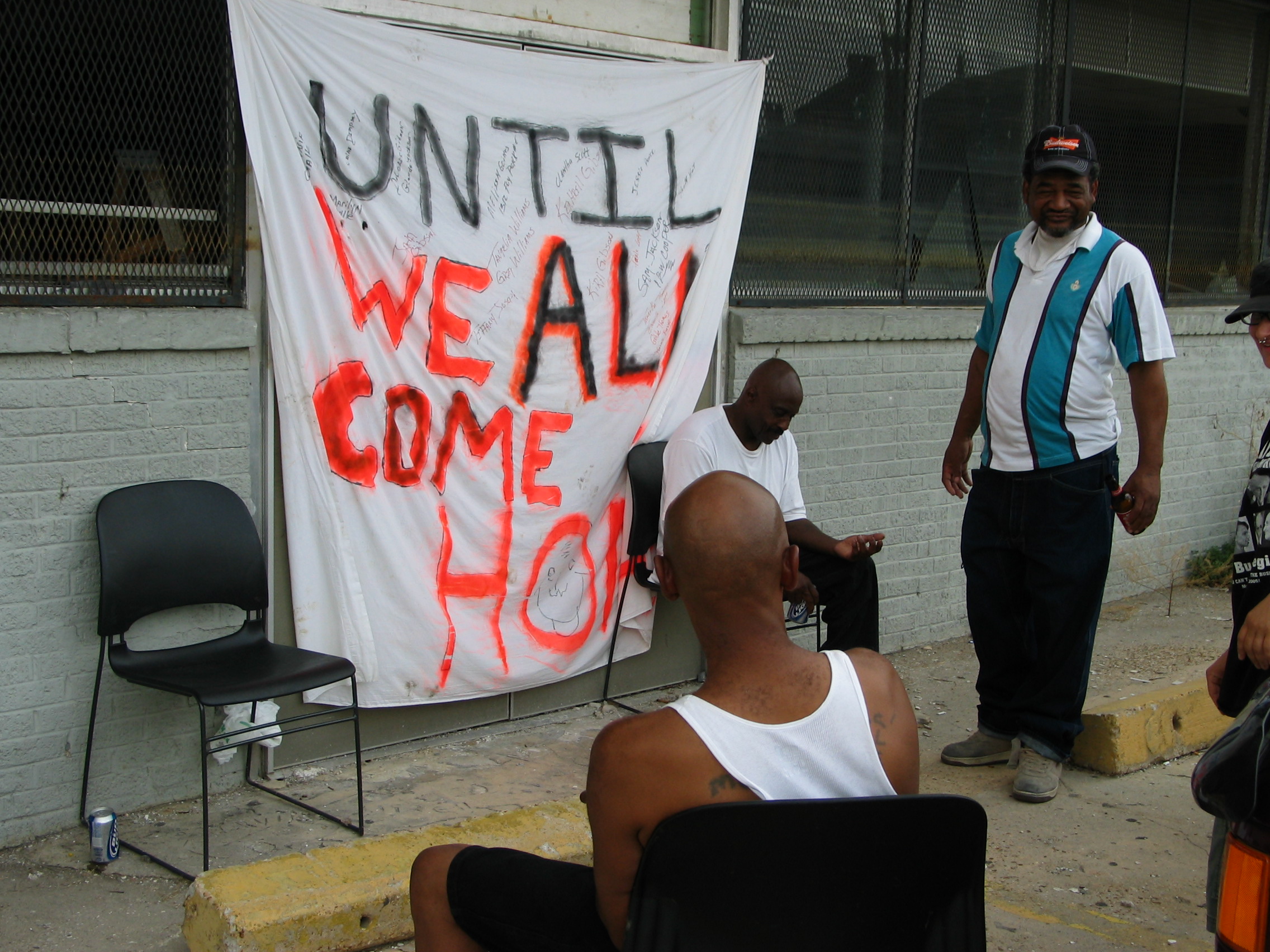 A bunch of the tents are down from wind, and no one put them back up. He says we need to move forward, to keep fighting for the housing to be opened up, that people need to be out here everyday.
In the afternoon a bunch of guys are sitting around. Emmett and Sam Jackson start discussing the housing project across the street. Emmett, says, ‘I don’t see why people want to come back here. It’s not home. They have new homes. They’re doing good where they are.’ Jackson says that people want to come home and they should be able to. He points out that the reason why Emmett was able to get out of public housing is because he had opportunities other people do not necessarily have. Jackson talks about how people do want to come back, not everyone has the resources to come back. Emmett asks how come more people from these projects go to Zulu club during Mardi Gras than come here to protest? Sam agrees but says that’s why we have to build the movement. Prachi points out its because people don’t think they have a chance to win. Rafael points to the banner that residents have signed that says ‘Until We All Come Home’ to show that a lot of people do want to move in. The banner has been up since the July 4 protest when many residents came back to protest in front of their old homes.
Sam and Rage talk about how there is no connection between bin-Laden and Saddam. They discuss how terrible the National Guard treated people and how New Orleans feels like a war zone. Sam tells Rage that people shouldn’t be shot at for trying to survive and that people should help each other, not kill one another. People in New Orleans are eager to discuss how they want the city to look and what it will take to get there. Sam focuses on education and getting people home when he talks about the future.
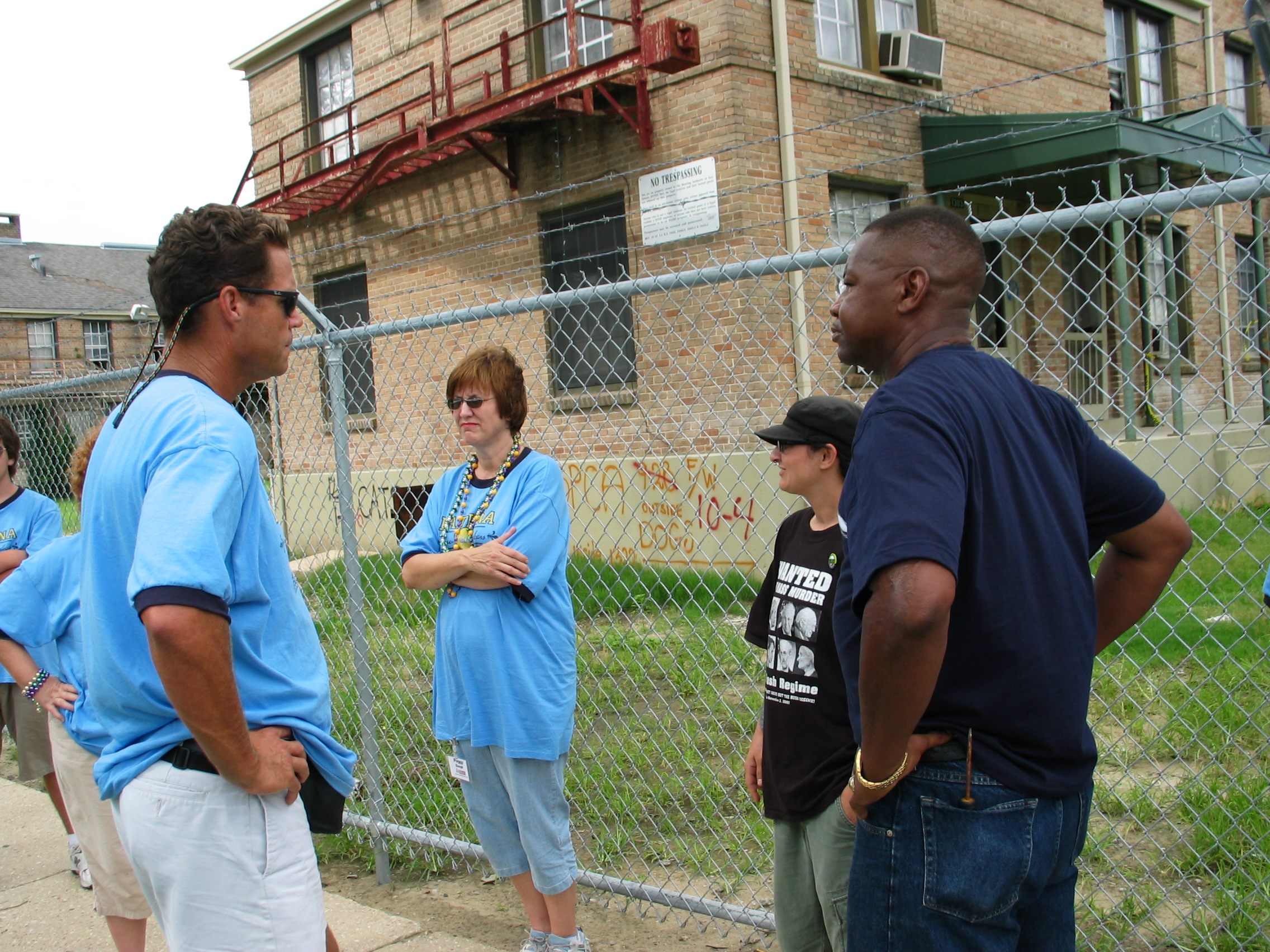 Rage, Prachi and Sam are outside talking about employment and education. Rage tells Sam about the experience WCW had in Fort Polk. Sam says that you can’t make assumptions about people ( don’t make assumptions about people in New Orleans or Fort Polk ( if people know what we’re doing and educate themselves they will like what we’re doing. While we are talking, vans pull up, youth and adults in blue t-shirts get out, some wearing mardi gras beads. Their shirts say ‘Hurricane Relief, Student Ministries.’ An older woman asks Sam about St. Bernard and he tells them about the housing struggle. Rage tells the group who we are and points to the Drive out the Bush Regime banner hanging on the fence. Prachi and Rage start to pass flyers. The older man who is leading the group takes the flyers away from the youth and hands them back to us. Prachi says ‘why don’t you let them see it, they should be allowed to see other information and make up their own mind.’ He says ‘they don’t need to see anything negative and we don’t think he needs to be driven out.’ Sam tells them that the struggle for public housing is not negative and that we are part of it. Sam and Rage start a loud conversation about who is responsible for the why people can not go home almost a year after Katrina. Rage points to the fence surrounding the housing and asks Sam to tell the youth who is directly responsible for it. Sam tells the youth that Alfonso Jackson is the person behind putting up the fence. Then Sam and Rage point out that Alfonso Jackson was hired by Bush himself. We have gotten better at challenging people with the truth of what I happened here in New Orleans. Sam really does an excellent job of bringing out the need to come out and fight for the right to housing and not simply praying to god in hope that it will all get better. We were able to speak in front of 25 young people, who just might visit our website. This group is telling young people that they just need to be rich in Holy Spirit. God didn’t cause Katrina, and God didn’t put this fence up.
World Can’t Meeting at the Surviors Village
We have a meeting with a few people, two people who are fighting for public housing to be re-opened, two Common Ground people, and two people who grew up in the projects across the street. Everyone there is ready to discuss the National movement to drive out the Bush Regime and how to connect people in New Orleans to it. We showed the DVD of November 2nd and people thought about having walkouts and general strikes on August 29: anniversary of Hurricane Katrina. Soleil says she want to put out a challenge to us to have WCW people actually come here to build a chapter here. She said people who come to New Orleans to do WCW work would be welcome at Common Ground. Prachi, Rage and Rafael think that we should put out our own call for people to come to New Orleans to organize a chapter. There was also a discussion of how demobilized people have become from the last mayoral election, one candidate called for the people to be shot at by the National Guard and the other candidate called for not allowing food and water being brought in. The comparison was made to the last election race between Bush and Kerry. Dale, who grew up in the Saint Bernard Housing Project, pointed out that there are still people who support Bush and that people will sometimes only act in their own self interest. He also brought up that Bush said that troops will not come home while he is in office. When asked if he thought it was possible to drive out the Bush Regime, he brought up the example of Nixon.
Fort Polk, La.
Elaine Brower, outspoken anti-war mother of a soldier in Iraq and World Can’t Wait activist arrived last night from New York. We all wake up early to pick up Ricky from Common Ground, a 19 year old volunteer from Toronto interested in having an ‘experience’ outside of New Orleans while he’s here. Ricky is a real conversationalist and we talk for 5 hours straight about topics ranging from apartheid South Africa (where Ricky was born) to those Canadian travelers that wear maple leaf flags on their bags to distinguish themselves from Americans, to whether it’s possible to drive out the Bush Regime, to the idea of ‘objective reality’ versus ‘relative truth.’
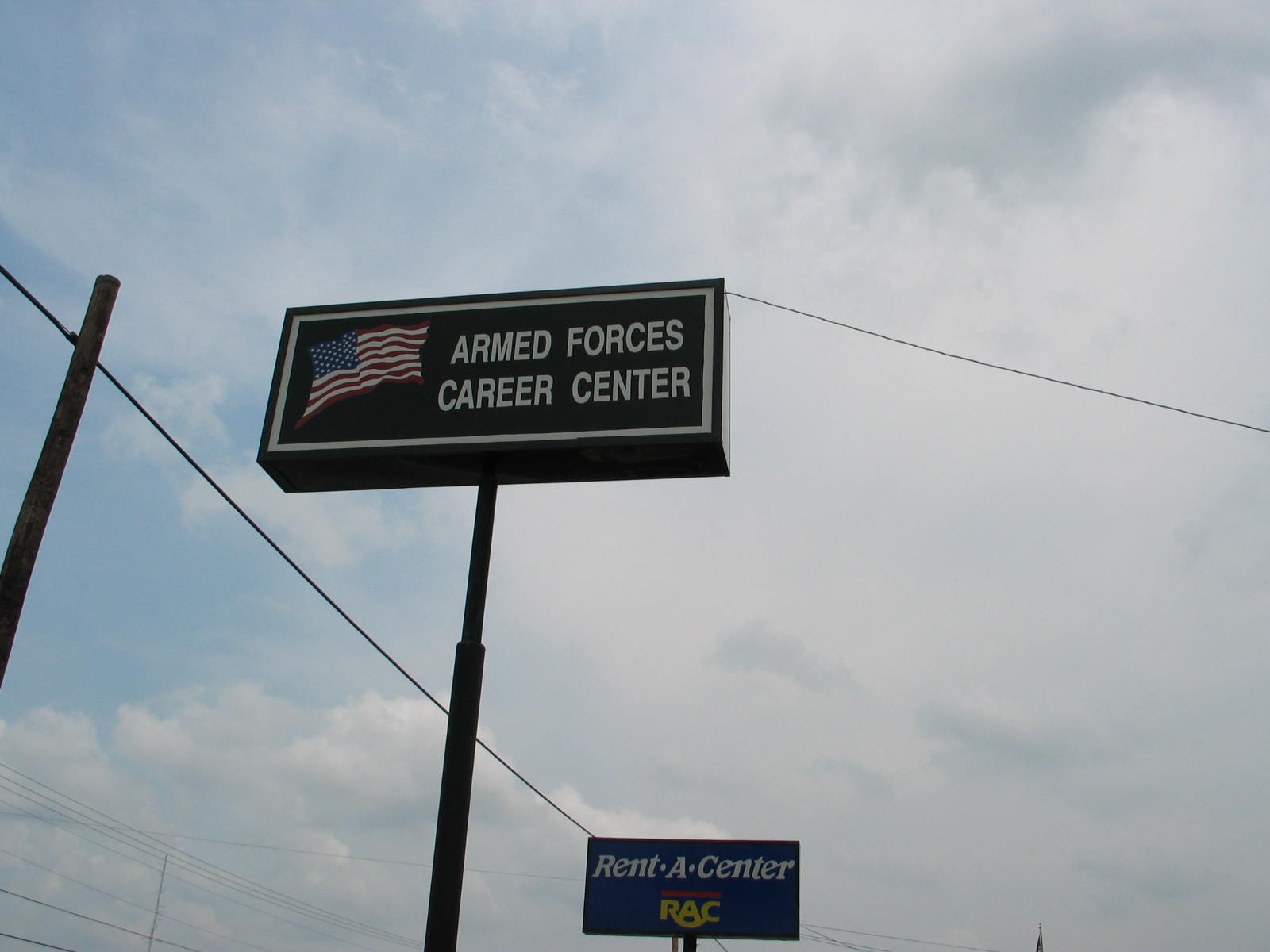 Fort Polk, Louisiana, is a huge military base that serves as a shipping-out point for service in Afghanistan and Iraq. It lays North-West toward Shreveport in real Bible-belt country. James Dobson, of Focus on the Family infamy, is the âDear Abby’ advice columnist in the local newspaper. As we drive by trailer parks and Pentecostal churches, boarded-up small-town mom and pop businesses and military recruitment offices, the state of rural America starts to make sense. One billboard has a picture of blue angels flying in formation and the caption says ‘bumper to bumper traffic.’ As we approach a synagogue called ‘Beth-El,’ surprised, I tap our Hebrew-speaking friend Ricky on the shoulder and point. But as we get closer I realize that it is not a synagogue, but a Pentecostal church. And then, one block farther we pass another Pentecostal Church, this one with an Israeli flag flying out front. Pentecostalism is an interesting religion. These days, it seems to be the religion of the oppressed. Very populist in its form, it appeals to the most dispossessed poor people in the world, from Honduran shanty towns to backroadsLouisiana. Part of the populist appeal is their extreme apocalyptic rhetoric, which is part of the reason they are such ardent Zionists ( because the rapture will only happen when ‘Greater Isreal’ (meaningSyria, Sinai, Lebanon, etc.) is controlled by the Jews ( who will then burn in hell of course.
Our small, but bold, group pulls up to Fort Polk. At the gas station in front we tell the two young cashiers what we are about to do. The woman cashier supports the military but says everyone prays that the war will end soon and definitely doesn’t like Bush. 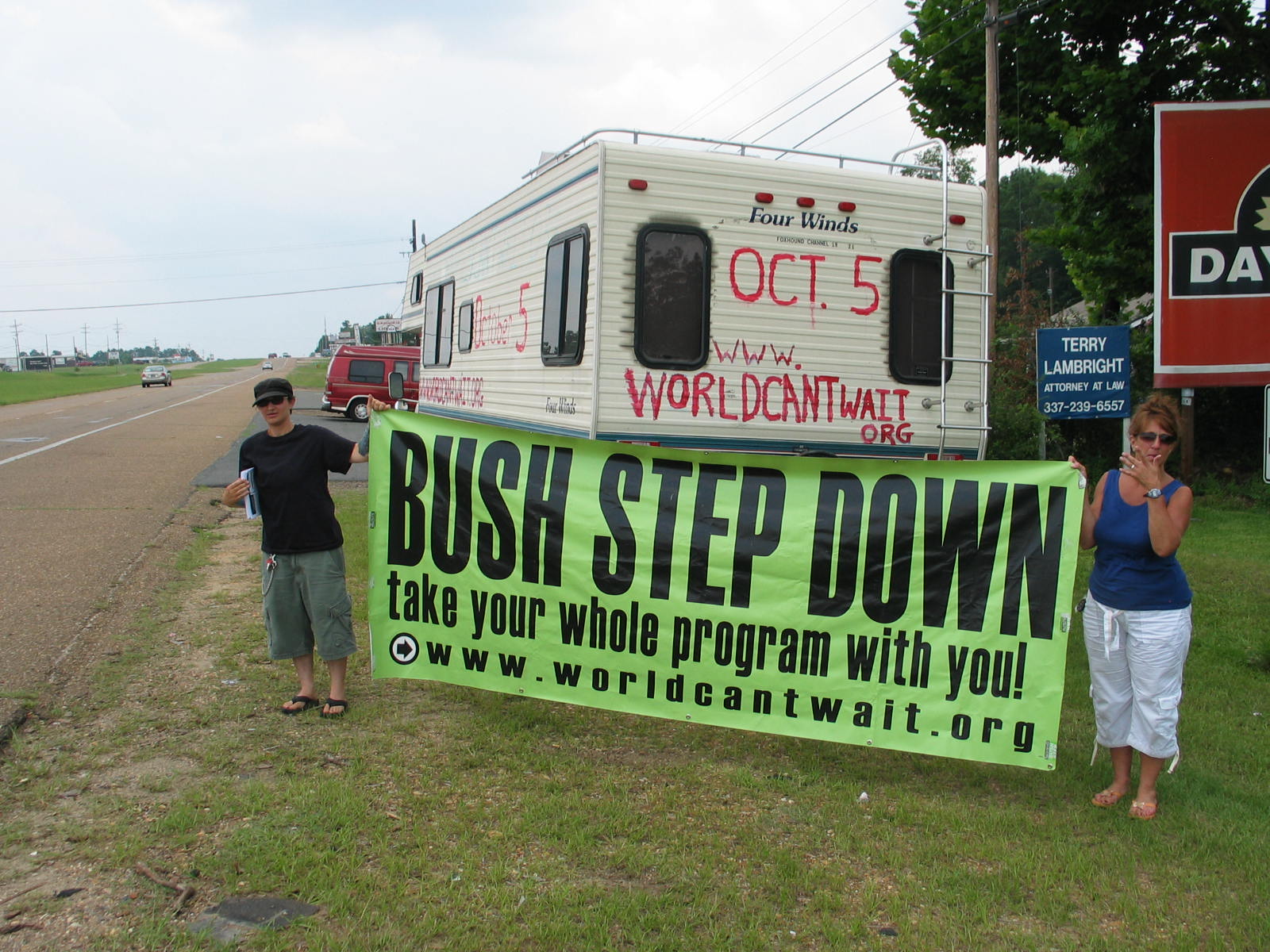 The other cashier is a black guy from New Orleans who tells us he’s seen KKK out here and wants to move home. We pull up to the Fort Polk visitor’s entrance and unfurl a ‘Bush Step Down And Take Your Program With You’ banner. Elaine’s got a picture of her son in Iraq with the caption: ‘Bring the troops home now.’ Almost immediately we get two middle fingers. But then a supportive couple from Pennsylvania stops to thank us. Even better, two women from Texas do a U-turn and scream how happy they are to see us. One exclaims, ‘I’m such a democrat, I have donkeys in my blood!’ They take a stack of flyers. A few truckers honk in support, and just as we’re starting to feel good ( like we’re actually expressing the people’s will on Bush’s turf ( a cop pulls up and tells us we have to find a private residence or business to let us do it, but not on state property. We quickly move up the road looking for supportive businesses. At the liquor store and the tattoo parlor, the workers ask for stacks of flyers to pass out, but can’t give us permission to set up the banner because they are not the owners. Finally we stop at a little repair shop with a bunch of rotting cars and an American flag out front. An old White man comes out. I have my doubts. But never make assumptions! The guy lets us set up on his property, providing us protection from the Louisiana state troopers that keep passing by us like wolves circling a tree where a cat has climbed up to hide.
Up the road, it’s more locals and less military, and our response rate is lower ( just a lot of inquisitive looks, like people have never seen a protest before. Truckers continue to honk though. One guy who thinks Bush is ‘a good honest man,’ stops to talk, but he’s friendly and thinks we have the 1st amendment right to be there. Two self-described ‘local potheads’ stop and take a bunch of flyers to distribute. Finally, sweaty and tired, we call it quits. Today was a good day. We were more conspicuous than we’ve ever been before. For the first time our RV felt like a political statement, and not just an RV.
Elaine heads to Houston and we head back to the Crescent City. On our way back we stop at a little roadside restaurant and I finally get to try Cajun food ( Shrimp Etoufee and a pistolette (basically Shrimp soup with rice and deep fried bread). I’m still waiting to try the hot and spicy quail eggs in a jar that they sell around here. The young waitress tells us that most people around here don’t like Bush because they have family in the military. Funny how, when the war was going well, that would be the reason why they would like Bush. On the ride home, Rage and I talk about the correctness of wearing the Haditha Massacre t-shirts, with a picture of a Vietnamese woman with a gun to her head ( like Mai Lai. ‘You don’t get to be neutral when you’re part of an occupying army,’ Rage says, even if you aren’t brutalizing people on the front lines.
On Monday, Elaine Brower will be on the show Flashpoints on Pacifica radio.
Day 6 – July 7th
A little tour of New Orleans with Sean
We started the day with Sean, a 29 year old Common Ground volunteer. Sean is a very interesting dude. Before moving back to theU.S. recently, he lived in Turkey , where he befriended an anarchist who had helped organize major hunger strikes in Turkish prisons. Sean is kind of an anarchist, and espouses a philosophy of ‘personal revolution,’ but he is very open to all sorts of ideas and we unite around the idea of driving out the Bush Regime. First he takes us to a coffee shop run by a hip Iranian guy in a bohemian neighborhood. We flyer to the mostly young white customers, but get our best response from a black woman with a baby who has just returned to New Orleans. Next, Sean takes us to ‘Ironworks,’ an anarchist ‘infoshop’ nearby and the only leftist bookstore in New Orleans . We leave flyers and talk to the person running it, who says that he met World Can’t Wait during the encampment in front of the White House leading up to November 2.
Next, we go to the Lower 9th Ward, the neighborhood hardest hit by the flooding. This is where the levee actually broke ( or, as the conspiracy theory goes, where it was blown up so that water would flood into this poor neighborhood instead of wealthier neighborhoods. It looks like an atomic bomb was dropped here. The concrete foundations of houses are still there, but the houses themselves have been washed far away. Within 6 or 7 blocks of the levee there is almost nothing left. Where a working class Black neighborhood once thrived, now there are only White Christian missionaries and camera-toting tourists. A lone intact house serves as a Common Ground distribution center for food and clothing. The residents (‘residents’ refers to New Orleaneans who were here during the hurricane as opposed to ‘volunteers’) inside all take flyers and are very excited about World Can’t Wait. The most poignant thing we see in the Lower 9th is graffiti scrawled on the side of an abandoned house that says ‘Baghdad.’ We had heard that this was here, which is why our banner hanging on that barbed wire symbol of inhumanity surrounding the Saint Bernard projects reads: From St. Bernard to Baghdad: Drive Out the Bush Regime!
As Sean drives us around more depopulated hurricane-ravaged neighborhoods, our theory is confirmed: if you want to find people you have to go to Home Depot or Lowe’s. Most streets are empty and businesses closed. We do find some action in front of a Chevron Station where a bunch of hungry drywalers are lounging in the shade of a taco truck eating chicharron. I stop to talk to Angel and Rogelio. Rogelio’s arms are covered with sureño tattoos and he initially seems too tough to talk, but within a couple minutes he and Angel are offering to buy me tacos) a different type of Southern hospitality. Angel and Rogelio are from Northern Mexico but had been living in border area of Texas until the hurricane (although they only speak Spanish). In Texas , they say, a laborer cannot make more than 60-70 dollars a day. Here they can make twice that. That’s why they’ve been here for 6 months rebuilding New Orleans (there’s a lot of drywall to be hung in a flooded city). But some of the other Latinos that have come here from Mexico and Central America are exploited and don’t even make minimum wage, they say. We get in a long debate, with Angel arguing that Black people are lazy and don’t want to work. Rogelio laughs as he tells me about some of the Negroes at the construction sites talking on their cell phones all day long as they paint. I tell them that they have to understand the history of slavery in this country and not to get stuck in a ‘divide and conquer’ framework. They know that some Black folks complain about Mexicans stealing their construction jobs, and I tell them that that’s not right either. But the point is that this Bush government is everyone’s enemy, and we can all unite around that! They agree and tell me about the great immigrants rights march they had here in New Orleans on May 1. I really wish I had Spanish flyers!
Dinner With Endesha
Endesha is a really cool guy. We’ve had our RV parked next to his FEMA trailer for almost a week, but we haven’t had much time to talk to this charismatic leader of the St. Bernard struggle. But tonight he knocks and invites us over for some spaghetti and garlic bread. Endesha is from the Saint Bernard projects and has a law degree. He went into law wanting to defend revolutionaries and activists who had been busted, but realized that he’d be more useful to the movement as an activist himself than as an attorney, he says as he points out that Lenin and Fidel were both lawyers that became revolutionaries. He describes the right-of-return struggle to Saint Bernard as a long, drawn-out, ‘protracted’ struggle, and describes their tactics as ‘guerilla’ ( fighting on many fronts, through the court and the city government, as well as through direct action. Although he has the aura of a wise old revolutionary and views dates like August 29th and October 5th from the big picture of ‘just another action in the protracted struggle,’ he clearly understands the value of changing the overall atmosphere in this country through a mass movement to drive out the Bush Regime ( particularly since he is fighting HANO (Housing Authority of New Orleans) which is now under the jurisdiction of Bush appointee Alfonso Jackson. That is why he says he’ll be at our meeting on Sunday and why he plans to help organize for October 5th. Equally important is that Endesha really seems to like us and respect that we came out to camp at Survivor Village for the first stop on our RV tour.
Common Ground
We make an announcement about our trip tomorrow to Fort Polk and several express interest. Unfortunately, many of the Common Grounders that we thought were going to come, including a member of Iraq War Vets Against the War, had to cancel because of a Common Ground community event happening on the same day. One woman with a cowboy hat, Emily, talks to us after the meeting. She grew up in Virginia and Missouri and now she’s on a warpath against the Christian Fascists. In fact, she’ll be meeting us in Mississippi with a couple carloads of Common Ground folks to confront Operation Save America ( the Christian Stormtrooper organization converging on Jackson’s last Planned Parenthood whose famous t-shirts read: ‘Abortion is murder, Homosexuality is a sin, Islam is a lie, and Jesus is the standard [!!!!!].’ Emily is very enthusiastic about what we’re doing and has connections to people doing similar things in Arkansas and South Dakota . Rage and I talk later about Emily, and how she is exactly the type of person that we came on this trip to find.
Despite spending hours driving around lost in New Orleans, like chickens with our heads cut off (not only are traffic lights still not working, but street signs are missing and gas stations and stores that would one could go for directions are closed), today was a good day.
Lowe’s
We started the day at Lowe’s (like Home Depot) buying supplies to make a new banner. Lowe’s is packed. In fact, it’s the biggest concentration of people we’ve seen since we’ve been in New Orleans. It makes sense right ( New Orleans is one big construction site) well actually, part of it is. The rest of the city (the majority) is a big junkyard ( more of a deconstruction site, rotting and being scavenged away.
We decide to take this opportunity to do some outreach among the folks coming in and out of Lowe’s, have some conversations and try to build for our Sunday meeting. It turned out to be a great environment for us, full of people focused (quite literally) on the rebuilding ofNew Orleans and intimately aware of the brutality of the man-made disaster known as Katrina. It was a blue collar melting pot. We talked to Brazilian contractors, Mexican and Salvadoran workers, Black and White people rebuilding their own homes. A Nigerian woman points to each of the four ‘Murderers’ on our ‘Wanted’ t-shirts (Bush, Cheney, Condaleeza, and Chertoff) and calls each one a criminal, then tells us she’s homeless and asks us if we know any volunteers that can help her rebuild her home. We refer her to Common Ground. Black folks, in particular, seem to be attracted to our ‘Wanted’ t-shirts, and many take the time to read the call right there carrying two by fours out of the store. A point of contention that we run into over and over again here is the abortion question, usually from people that say they agree with every other point in the call. Another thing I hear over and over again here is:5 days . Everyone’s got a survival story about the 5 days they spent before anyone came to rescue them. Overall, it was a very interesting and positive experience for us. We just wish we had Spanish flyers for all the Latino laborers crowded around the taco trucks in the parking lot.
A new banner
Our banner here, on the barbed wire separating Saint Bernard public housing residents from their homes, has become a fixture that people seem to like. But it is falling apart, so we make a new one. It reads:
FROM ST. BERNARD TO BAGHDAD
DRIVE OUT THE BUSH REGIME
www.worldcantwait.org OCT. 5
Meeting with Mike Howell
Mike Howell, a longtime activist and New Orleanean is on board to be part of this developing World Can’t Wait core in New Orleans. This is exciting! We talk about the political and economic history of New Orleans and Mike’s activist history. We talk about organizing for August 29 (the one year anniversary of Katrina) and October 5. We talk about the public housing struggle as a microcosm of the national political situation, where a violation of international law is committed, it is continued in the face of protest, people become demoralized and eventually accept the injustice as the new normalcy. This is the fork in the road thatNew Orleans residents are at now. They can either move forward, upping the ante in their struggle, or they can accept exile or dispossession and homelessness in the new Cajun Disneyland that they have planned. As it is, a lot of people are demoralized because they expected an occupation of Saint Bernard to begin on July 4th. Mike thinks an occupation will be necessary, or else we will lose and go backwards. He plans to advance the struggle and sees WCW as a key link to the exiles inHouston and Atlanta (in building for August 29), as well as an important way to change the terms of debate nationally.
Iberville Meeting
Iberville is another big public housing project in New Orleans, but one that is slated for redevelopment, not demolition. The meeting was an interesting mix: 3 housing rights activists, 3 Iberville residents, 4 Common Ground volunteers, 1 graduate student writing his dissertation on the ‘Right to Return’ movement, Rage and I, and strangely, a slick developer with big plans for Iberville. Michael Valentino’s presentation was interesting in its slickness. He wants to redevelop Iberville with ‘a better quality of life,’ to ‘break the cycle of hopelessness,’ and make sure that it does not go back to being ‘overrun by bad elements,’ the way it was before the storm. He uses code words like ‘viable community,’ ‘practical plans,’ ‘safe and responsible housing,’ to justify his ultimate plan to flip the paradigm from housing as aright to housing as a ‘privilege .’ Thus, public housing becomes ‘transitional’ housing, and the clock starts ticking (60-72 months) when you’re given the boot to ‘independent living’ ( which everyone wants of course. Plus half the units in this plan will be for ‘middle income’ rentals. Rage has to hold me back ( because we came toNew Orleans to build the movement against the Bush Regime and not to debate the details of city planning ( but housing is a human right, like sexual and reproductive freedom, habeus corpus and other casualties of the Bush Regime!
Conversation with Keith
Keith asked us for the time and a cigarette and we stopped to talk. What a smart decision that was. Once again, the ‘Wanted’ t-shirt that Rage was wearing sparked an amazing conversation. Keith is 19 years old, with two kids and two on the way. He used to live in the St. Bernard projects and spent the aftermath of Katrina getting harassed by the National Guard at the Convention Center. Although he doesn’t have a GED, he’s very passionate about politics, and curious about the world. He wonders why his future’s already been decided for him and thinks the system’s rotten. He asks why so many people are suffering and have no hope in the richest country on earth. He envisions a better world where there would be schools on every corner instead of liquor stores, where they’d send teachers (teachers who care, not the ones in New Orleans public schools that have already given up hope) into poor communities instead of troops, and politicians actually cared about the people. Ray Nagin doesn’t care. Bush, Keith says again and again, doesn’t have a heart. He talks about his cousin in the military and how he joined up wanting education and a house and doesn’t have any idea why he was sent to Korea. We’re very glad we stopped and gave Keith the opportunity to reveal himself ( his bitterness and his hope. He takes flyers for the people on his block and says he’ll bring friends to the meeting on Sunday.
Talking to the residents: Rage and I strategize about how to maximize our impact here in New Orleans. We realize that by staying at Survivor Village and having in-depth conversations with the residents that come through there ( really listening to their grievances and stories ( we have become fixtures here. People tell us they are glad we’re here and are eager to talk to us. They seem to like our banner and the painting we’ve done on the RV. We hope that through having an ongoing discussion group here in front of the RV, we can inspire people to become involved with World Can’t Wait Drive out the Bush Regime.
Conversation with Byron ‘Dust’ Honoréx:
Byron grew up in the St. Bernard housing projects. It says ‘housing development,’ but to Byron, he grew up in the ‘projects.’ He spent several days in the Superdome, ‘the worst time of my life,’ he says. He tells us about running into a dead cat as he’s swimming to the Superdome and describes what seems to be symptoms of Post-traumatic stress disorder from what he experienced. Whenever he smells certain smells he thinks of the Superdome. He sometimes has nightmares about being underwater and trying to swim upwards towards the surface, but before he gets there, he runs out of air and wakes up. He tells us about babies sleeping in their own feces (where could anyone get diapers?), little kids walking around naked by themselves with no parents, and women taking baths together in a giant water tank with everyone walking by and no self-consciousness about their bodies ( normal social mores had broken down. He tells us about the National Guard telling him they’d shoot him if he crossed the barricade they’d erected around the Superdome. According to Byron, someone actually took a National Guards’ gun and got shot. After the National Guard left, he said, the 2nd floor became like a whore house, with people smoking crack and shooting up to pass the time. It was like being on an island by yourself, with no one from the outside world to tell your feelings or fears to, he says.
Everyone knew that sooner or later New Orleans was going to hit with a big one, Byron tells us. They had been too lucky before, and hurricanes had missed the city. Why did they build the levees only 35 feet deep, when they must be 60 feet to hold up? They didn’t give a shit about us, only the money in their pockets, he says. No one cares aboutNew Orleans . ‘How are they going to put a fence around here?’, Byron asks, pointing to the barbed wire around Saint Bernard. How much money did it cost them to put that fence up?
Byron is glad to see Endesha and Roland, old friends from St. Bernard. We’ve seen a lot of happy reunions here at Survivor Village.
‘Growing up in New Orleans the only whites we saw were police, coming into the projects to spy on us or send in drugs, get us killing each other, genocide in that way.’ Some people in St. Bernard had never even been toCanal Street , Byron says. We definitely wouldn’t have been able to come here with that RV before the hurricane, he says. It would’ve gotten jacked in a minute.
According to Byron, Tent City is the best thing that could’ve happened. Seeing people everyday here shows that people really want to move back in, that people care about this place. He says that he’s not into using force to tear down the fence, but then says that he wants to do it, he just doesn’t want anyone to see him. For Byron, it’s wrong to force yourself in, but they forced him out, and that’s messed up. We tell him thathe’s the one that has had injustice perpetrated against him, so he actually has a ‘right to return.’
‘This was already in the plans,’ Byron says, ‘and they used the hurricane to put their plans into motion.’ Saint Bernard is made of concrete and brick, unlike some of the other housing projects in New Orleans that rotted because they were made of wood, plywood, and sheet rock. ‘All you have to do is pressure wash it, put primer on, and turn on the electricity.’
But they don’t want people like Byron back in New Orleans.
A woman drives by asking how she can get her old car out of St. Bernard. She says she’s been calling HANO and can’t get through to them. I’m amazed that this conversation is happening almost a year after the hurricane!
She’s an organizer of survivor village. Said when survivor village started there used to be many more people out here ( they used to come on their lunch breaks. She wants to see that again.
She understands that things can’t stay like this, they need to move forward.
Conversation with Wali:
He used to live in St. Bernard. He said they don’t want people to come back and the way they’re keeping people out is through privatization. Our conversation drifts from Katrina and Bush, to his conversion to Islam inside Angola state prison, to ‘irisology’ (the science of figuring out your ailments by looking at your eyes), to horticulture, Creole culture, Stokely Carmichael, and books about guerilla warfare. He came back to New Orleans recently (from exile in Houston) to work, but now he’s homeless because his alcoholic brother (addicted to ‘fermented beverages’ as he puts it) kicked him out.
Wali has got a certain type of philosophical idealism, probably acquired in prison as a form of escapism. He seems like the intellectual type, that while he agrees with what we’re doing, might be too deep into philosophizing to actually involve himself in a real material struggle and might stand on the sidelines instead. On the other hand, he’d make a great ‘driver’ or revolutionary. I admire him because he’s the type of street intellectual, renaissance man with a wealth of experiences (from fishing in the Bayou to the army, to drugs, to prison, to Islam, to literature and science), that I strive to be.
He agrees that the Bush regime needs to be driven out, that we need a people’s movement, but he’s not sure what his role is.
Brainstorming meeting with Mike Howell:
Mike Howell is the leader of United Front for Affordable Housing, an organizer in the struggle for public housing in New Orleans, and very interested in linking up with WCW. Mike announces other events relating to the Iberville projects, which actually have been opened, but have terrible conditions due to a lack up funding. We sum up yesterday’s July 4th event. It was a good turnout, around 250, with about 60-70 residents showing up. It was the first time that public housing and the demand for its reopening have been on the agenda, and shows that they can’t shut down the projects without a fight. And if public housing is reopened it will drive down the cost of private housing, allowing more low income people to move back to New Orleans. Some at the meeting criticize the event for having too few residents. Sam ‘Action’ Jackson points out that in order to tear down the fences they need more residents involved in this struggle. Others point out the problem of bringing in residents from other cities and states. Mike Howell mentions the civil rights song ‘We Shall Not Be Moved,’ as a sort of theme song in the movement ( a song that Gloria (an older leader in the St. Bernard struggle) was singing during the July 4 march. Mike Howell points out that the struggle for right to return for New Orleans residents must be taken up on a National and International level, which is true. World Can’t Wait Drive out the Bush Regime recognized that this injustice in New Orleans is one of the Crimes of the Bush Regime.
August 29th will be the 1 year anniversary of the hurricane. There is the potential for a major outpouring from all over the country, coming to New Orleans ( coming home ( to be there on 8/29 to protest the injustice during Katrina and the continued injustice one year later, with FEMA checks running out and people being left homeless. We propose that WCW chapters in areas where people from New Orleans reside ( particularly Houston and Atlanta, but also N.Y. and S.F. and others ( take up an event in August (something like a speak out) as a springboard to bussing people in to New Orleans for August 29th. We also propose that October 5th be taken up as the next step, bringing their particular New Orleans grievances/reasons why the Bush Regime must go. Overall, people think that WCW could be a key link to the New Orleans Diaspora.
Day 3 ( 4th of July Day of Resistance at Survivor Village
We started the day at Target picking up some refreshments for the barbeque later on. Rage was wearing the Wanted shirt and lots of people asked where they could get one. We then went back to the tent city and made a banner that said From New Orleans toIraq Drive out the Bush Regime. After asking Endesha if we could put it on the fence of the housing projects and only being warned that the police might remove it, we put it up. Throughout the day the wind kept pulling it off and people would spontaneously come and help put it back up. Many groups followed our lead and put up their own banners and signs on the fence, but now ours is the only one left. We focused on talking to residents about driving out the Bush Regime and inviting them to our meeting on Sunday night. Many told us their stories of the hurricane and how they have been dealing with living in another city and state, how members of their family are all over, how the police treat them, and why they want to come back toNew Orleans and really live here. I was told by one woman that the news I heard about New Orleans was wrong, that people here are good and that the National Guard did not save them, they had to save themselves.
It was an emotionally heavy day. How does it make sense that we’re getting wireless internet while people are sleeping in tents and can’t get into their homes? The march and protest today was 25% residents, 75% Common Ground people. I was struck by the fact that they didn’t need permits, march routes, etc., because there are not any people here. We marched in the street and made noise but no one was around to hear or see us. There’s no one to cheer as you walk by. It’s a refugee camp. The march around the perimeter of the fence to symbolically make the walls ofJericho come tumbling down. Supposed to be 7 times around, but people were tired. Zydeco music gets people dancing)
The music that plays before and after the protest is loud and people dance for hours. The music stays on till late because there’s no one to complain about it. There were 4 HANO police and the National Guard drove by once and waved. Think about what would’ve happened if they’d taken the fence down, how quickly the National Guard would come. But they announced from the stage that they wouldn’t tear down the fence. Things said from the stage all had the same sentiment ( we want to go home and we should be able to. There were also thanks given from the stage and recognition of the people coming from outside to help the residents.
Mike Howell tells me a story, appropriate for the 4th of July in the most neglected corner of America ( a 3rd world scar on the face of this wealthy country: after Katrina in the French Quarter (where Mike lived and used to see a lot of Red, white and blue), gradually as the days and weeks went on and people still weren’t seeing the red cross or any aid, they started taking down their American Flags and putting up Louisiana flags. He also tells me about how capitalist laws of exchange collapsed after the hurricane. People were looting, but they were looting so that they could distribute the food and supplies to everyone. No one stole from each other, only from stores. There was a real spirit of cooperation and self-sacrifice that emerged spontaneously, a sign in his eyes that another world is possible.
Speaking Bitterness: almost any resident you talk to will start venting about the injustice perpetrated against them. The woman with the gold teeth in the picture busted out a stack of photos she took during the flooding ( I wonder if she keeps them in her purse all the time to show people what she went through. She tells me how people got out of the projects to dry land: they took the doors off their refrigerators to use as boats and paddled away with. She says that she’d have been treated better if she was a tsunami victim inIndonesia.
Rafael’s speech: people started cheering when he says that we should tear down this fence and wrap it around the white house, then evict the Bush regime and not let them back in just like people here are not being let back in) then we should put them in prison because that is where they belong.
We will get up early tomorrow with the residents and start building a chapter.
Day 2, 7/3/06
We come into New Orleans. The destruction is like nothing I’ve ever seen. Buildings are in disrepair, abandoned cars and other junk litter the streets. In fact, many streetlights still don’t work. Think about that ( if this was a city that they wanted people to move back into (and not bulldoze and gentrify), wouldn’t fixing the streetlights be an easy first step that could’ve been done right after the hurricane. It’s almost a year later.
We stop at Home Depot to pick up some paint. A lot of Latinos are hanging around and, in fact, there are 2 taco trucks parking lot. I stop for some al pastor and talk to the guy inside. He’s from Guerrero (Mexico), and came 1 month after Katrina. He said a lot of gente have come, but it’s starting to slow down now, and there’s not as much work. How much do people make working on the rebuilding? He says about $60-100 a day. Not bad for a days work, but I had to run so I didn’t have time to ask him about the toxic conditions and lack of labor laws for these migrant workers.
We meet with Michael Parker, an activist from Shreveport La. He runs an art gallery/bookstore and is very interested in starting a Louisiana chapter of WCW. We talk about how Shreveport can link up with the people of New Orleans. He says that Shreveport is very conservative ( Northern Louisiana is much more conservative than Southern ( and it’s extremely segregated. We talk about how WCW is a way to break down racial barriers andSouth/North LouisianaFort Polk and wants us to speak and show anti-war videos in Shreveport.
We arrive in ‘Tent City’ ( also known as ‘Survivor Village’ — basically a bunch of tents in the median of the street in front of the Saint Bernard housing projects. We meet Endesha (one of the main organizers in the survivor village struggle), a couple of the Saint Bernard ex-residents, and some common ground volunteers (one youth fromFloridaJackson with us). We talk with Endesha about WCW ( he says ‘people here were against Bush way before Katrina ( and building a resistance movement that can hold these Presidents accountable. Clinton was slick, but Bush openly exposes the contradictions, so he’s the best president we could have right now.’ We talk about the question of the word ‘refugee’ vs. ‘evacuee.’ He says he uses ‘refugee’ ‘because that’s what they turned us into. Evacuees are temporary. We’ve been kicked out for good. Some people think ‘refugee’ is a vulgar word, but the way I see it, we’re being treated more like those refugees inSomalia or Palestine than some ‘Evacuee’ that gets to come back.’ wants to come to
I’m very nervous, but do an interview for Flashpoints on Pacifica radio about the Bus Tour.
Rage meets an older woman in just outside survivor village that tells her that Katrina happened because God was punishing people (taking a line straight from Christian Fundamentalist preachers), and you can’t question God. The woman said she missed her neighbors and was not sure if they would come back. Her son and grand-son were fixing up her house. Rage told her that it looked like she had a good family and have a good night. Hopefully we will get a chance to talk to her again.
Everyone’s got an interesting name: Endesha, Malcolm, Sam ‘Action’ Jackson, Eddie ‘punch in a pot’ Sears (from St. Bernard projects). Eddie and I get in a long discussion about the call. He agrees with everything except the abortion part. ‘If she fucked him, she’s gotta deal with it!’ But he doesn’t think abortion should be against the law. He’s very knowledgeable about the world and current events, but has some distorted ideas about Arabs: Why’s Bush got a war in theMiddle East when he lets them come into poor neighborhoods and set up shop? He tells me how they want to kick the poor and black people out ofNew Orleans, speaking bitterness as he sips a tall can and smokes a black and mild.
Endesha leads the ‘Survivor village’ planning meeting (planning for the July 4th day of resistance. There’s an interesting discussion about whether to try to tear down the fence as a symbolic act or whether to circle the fence 7 times, like the walls of Jerico, in the Bible. Endesha says that they don’t want to tear down the fence until they have the resources to actually occupy the buildings. And that would mean having ex-residents (many who are now basically homeless, and more soon with FEMA checks running out) willing to face the consequences of civil disobedience) and this would require political work with them. The meeting is mixed, about half from New Orleans and half not, half black and half white. We meet Halli and Mike Howell. Both are down with WCW.
We go with Halli back to Common Ground. It’s a very interesting place, sort of like a leftist (especially anarchist) summer camp. I’m excited to meet some people from the Bay, one kid from Oakland Tech and a young woman about to transfer to UCB. I’m surprised by how young everyone is, many in fact are still in high school. Later we hear a presentation by some people from Iraq Vets Against the War. One of them in particular is interested in participating with us on July 8th at Fort Polk. There is some interest among Common Ground people in coming to Jackson with us too.
As we drive the RV through Alabama we see signs everywhere: ‘Wallace for Lt. Governor.’ I’m thinking George ( ‘sick the dogs on âem’ ( Wallace. Or Rasheed and Big Ben’s great-great grandfathers’ slavemaster. Welcome to the South, where the bloody history is thick like the air down here. Place-names recall that history, and its present day forms, as we pass through. Bob Jones University, Tuskegee, Selma, Fort Benning, Charlotte N.C. (where Operation Save America was 3 years ago), East Point and Decatur (I’m an Outkast fan), Mobile, Buloxi, and finally to the place with the most notoriety ( New Orleans. It all looks pretty generic from the interstate, but with giant ‘Jesus Saves’ crosses and different fast food joints from the places I’m used to (full of big people with Southern accents) ( Cracker Barrell, Arby’s, Waffle House, Huddle House, etc. There’s a Hooters at every other exit. Rage and I have a discussion about whether Hooters waitresses have internalized oppression or are cynically working there because it pays better than McDonalds. It’s probably a mixed bag. As we’re walking out of Subway, a couple mothers with their kids give Rage the ‘what-can-I-do-to-keep-my-kids-from-turning-out-like-you’ (as she put it) look. I won’t say what Rage looks like, but she’s definitely got that ‘not from around these parts’ style. When we start having engine problems with the RV, I ask Rage to go into the gas station with the sign in the window that said ‘American owned’ (as in, not Pakistani) ) and she says that I better do it, because we actually need to get help. When we want to stir shit up, she’ll be ready. Coming from the twin pillars (Sodom and Gomorrah if you will) of decadent-mongrelized-judeo-homo-sin ( N.Y.C. and S.F. ( I worry that unity-struggle-unity could be a struggle for us if we’re afraid to interact with people, or if they’re afraid to interact with us. We are not their saviors and ‘they’ are not the enemy. After all, if we are going to drive out this regime, places likeMississippi and Alabama are going to have to be hotbeds of resistance ‘behind enemy lines.’ Our task is to find those people ready to resist. How? By going to contested and contentious areas, sites of struggle, and cracking shit open. We spend a while clarifying this. We are not going to these places to be ‘organizers,’ in the slow and deep sense ( we do not have the time or resources; neither are we going on this tour to deliver materials or be some kind of link between the chapters and the national organization. We are going to break shit open, by boldly standing on the front lines of fascism and fighting with the spirit of Mario Savio, freedom riders in the battle for future.
I’m surprised by the number of Latinos in the cars and fast food restaurants. Funny how having a Mexican flag and a Virgin of Guadalupe decal on your car in ruralSouth Carolina has become as dangerous as a rainbow flag. It seems that the South is no longer a black and white world) I realize as Shakira plays on the Spanish radio station. I’m also surprised that I haven’t seen any Confederate flags yet) ‘fire hazards’ as they say. I wonder if the people still mad that the South lost the Civil War don’t feel the need to be separatist anymore. I mean, after all, they have state power! But Red, White, and Blue flags and yellow ribbons are omnipresent. It’s funny, since one of the few tapes that I randomly grabbed was an old John Prine tape that my dad made for me, with the song: ‘Your flag decal won’t get you into heaven.’ What’s not funny is (as John Prine said himself in a recent interview) how relevant that song still is. It all reminds me of the Boondocks courageous post-9/11 ‘Adventures of Flagee and Ribbon’ series.
As we’re looking for an RV park outside of New Orleans, we see an RV parked in front of a fireworks stand and ask them where the rv park is. Real nice folks (southern hospitality), they say that there’s one up the road, but it’s a FEMA park now. But, she says, ‘you don’t want to go over there baby. There’s some people there you don’t want to get too near.’ Poor black people? Is that what she meant? This is our first introduction to the reality of a devastated people, a reality which will become more stark in the days to come.