
February 15, 2008 New York Times: The Army Recruiter is Not In
February 12, 2008 Protests in Berkeley CA Against Marine Recuriting
Indy Media Bay Area: Berkeley Changes Anti-Recruitment Language
Contra Costa Times VIDEO: Protests Heat Up
Daily Californian (UC Berkeley) PHOTO SLIDESHOW Over 100 High School Students Engage in Protest, Some Drawn In by Anti-War Group
Podcast: Listen to a debate at the anti-war and pro-military protests outside
City Hall between Darnise Gray, mother of a Marine, and two Berkeley
High School students, junior Julia Drummond and freshman Julian
Taquechel. Reporting by Selina MacLaren.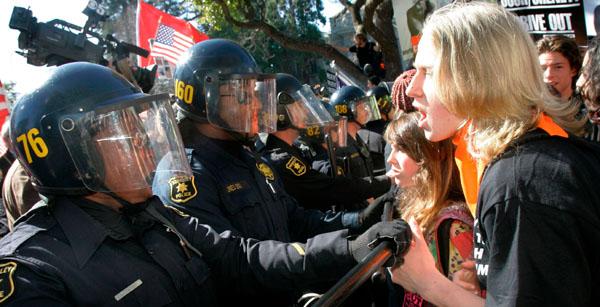
San Jose Mercury News: Day of protests precedes Berkeley council meeting on Marines issue
and Marines can stay in Berkeley, without an apology from City Council
Fog City Journal: Berkeley council against Iraq war but ‘supports’ armed forces
Newsweek February 13 2008:The Military vs. Berkeley – Will the latest antiwar activism have a ripple effect?
February 15, 2008, 6:30 pm
The Army Recruiter Is Not In
 Protesters
held signs and chanted outside the Army Career Center at 126 East 103rd
Street, in East Harlem. (Photo: Jennifer S. Altman for The New York
Times)
About 20 antiwar activists gathered outside an Army recruiting
office in East Harlem this afternoon to protest what they described as
the military focus on persuading young blacks and Latinos to fight in
Iraq. But if their aim was to disrupt recruiting, they did not. The
office had already been closed for the day, with a metal gate drawn
down over the plate glass windows.
Capt. Charles V. Jaquillard, the Army Recruiting Command’s company
commander for New York City, said the East Harlem office was not closed
because of the protest. “We were conducting a training,” he said. “We
had everybody out at Fort Hamilton today.”
After a 1 p.m. news conference at City Hall, the demonstrators gathered
at 3 p.m. outside the new Army Career Center, which opened two years
ago, at 126 East 103rd Street. They marched and chanted outside the
closed office, as two New York City police officers looked on.
“The question of military recruitment is important because you can’t
carry out this war without fresh troops,” said Debra Sweet, the
director of an organization called World Can’t Wait! Drive Out the Bush Regime.
“These troops are being trained to carry out war crimes. We”re sending
a message that military recruiters are not welcome to prey on youth.
The war will be stopped by the action of the people. That is the only
way it will be stopped.”
Ms. Sweet said that Latinos have been disproportionately represented
among service members who have fought and died in Iraq. (The Times reported last year that the Army has focused much of its local recruitment efforts on public events popular among Hispanic New Yorkers.)
Stephanie Rugoff, a volunteer with the antiwar group, said that
“military recruiters go to neighborhoods with high unemployment” and
make inflated promises of education and work training.
“What are they recruiting for?” the protesters chanted, replying: “Murder, rape, torture, war!”
They held aloft signs with the messages “Say No to the Military
Recruitment Center” and “Shut Down The Military Recruiters! No Iraq
War! Drive Out Bush Regime!”
One protester, Elaine Bower, whose 26-year-old son recently returned
from Iraq, asked, “Instead of putting a recruiting center why don’t
they put a place where kids could work?”
Captain Jaquillard disputed the protesters” assertions that the Army
disproportionately targets minorities. “The Army provides opportunity
for everybody,” We”re looking for qualified applicants. Some may live
on the Upper West Side, some may live in the Financial District, some
may live in Harlem. We put in individuals who have chosen to serve
their country, of various backgrounds. There’s something that the Army
offers for everybody. I don’t believe we target one demographic over
another.”
The Army’s New York City recruiting battalion is based at Fort Hamilton in Brooklyn.
“An Army is a reflection of its people,” said Emily Gockley, the
chief of advertising and public affairs for the battalion. “America’s
Army is a reflection of who and what Americans are. We have the largest
recruitment mission, because we need the most people.” She said that
the Army’s demographic makeup largely reflects that of the population.
Ms. Gockley acknowledged that the Army uses marketing and
advertising agencies to specifically reach out to potential black and
Hispanic recruits. “Just like McDonald’s markets to the
African-American community differently than it does to the Hispanic or
Caucasian community, we do the same thing. We apply the same marketing
strategies, market segmentation. We look at various groups – white,
blacks – with the propensity to enlist. It’s very complex. When they
put a recruiting station in a particular area, it’s not because it’s a
minority area. In fact, we had a grand opening today for a new
recruiting station in Massapequa, Long Island.”
Even though there were no military officers to greet them, the
protesters today were undeterred. Around 4 p.m. they left the shuttered
East Harlem recruiting office and made their way toward a joint armed
forces recruiting station at 76 West 125th Street, in Harlem, where
they planned another demonstration.
Dmitry Kiper contributed reporting.