
October 22
LOCAL ACTIVISTS REPORTED 50 PEOPLE KILLED SINCES CLASHES ERUPTED IN AL-JAZIRA STATE AFTER PARAMILITARY COMMANDER DEFECTED…. In Wad Madani, a military air strike on a mosque killed 31 people. They accused the army of using barrel bombs,…over half of the dead remained unidentified as rescuers combed through the remains of “dozens of charred and mutilated bodies.” The 2 forces are currently locked in brutal combat over central Sudan’s agricultural al-Jazira State. The army announced that RSF’s commander abandoned the paramilitary force,…in what was the first high-profile defection to the military’s side. Mere hours after the army took control of Tamboul…eyewitnesses reported RSF troops were back rampaging through the city. They said paramilitary soldiers were shooting randomly in the air and forcing civilians to carry looted cargo.
RSF has long been accused of rampant looting, laying siege to entire villages and systemic sexual violence in al-Jazira and across Sudan. Both sides have been accused of war crimes including targeting civilians, indiscriminately shelling residential areas and blocking or looting aid. In Rufaa, just 50k north of the state capital, the local Resistance Comm said RSF attacks on…villages in east al-Jazira resulted in 20 deaths. The activists accused paramilitaries of carrying out “vengeful operations against defenseless” civilians…. Central Observatory for Human Rights: at least 7 towns and villages have been hit by “vengeful attacks that pay no heed to the rights of civilians during wartime.” Al Arabiya


October 21
AS FIGHTING RAGES, FOOD KITCHENS BARELY MAINTAIN SUPPLY. Free kitchens, or Takias, are now facing shortage of funds and supplies, as fighting continue to rage around Khartoum. The prolonged conflict….has caused severe damage to agricultural production, one of the country’s pillar industries….Khartoum and its surrounding cities N Khartoum and Omdurman are among the most intense conflict areas, with 5m residents trapped. Most…lost sources of income, but the prices of food and daily necessities have soared several times higher than before the conflict. In addition to fleeing from air strikes, shelling and gun battles, people are facing difficulties such as water and power outages, as well as food shortage. In desperation, some Sudanese have set up Takias to provide free food to families who have run out of money and can’t feed themselves.
Takia originated from the Arabic word mutaka. In Sudan, it refers to a place where people perform religious rituals, such as memorization of the Holy Quran by religious students, while also serving as a sanctuary for the impoverished and needy, providing them with access to food and refuge. 350 Takias have been set up in the capital and surrounding cities, helping 500,000 families. Takias are generally very simple and set up in residents’ homes. “We set up 6 Takias…Some provide breakfast, while some others provide lunch. Each Takia can provide food for 220-250 families, usually rice, millet or beans,” Muhammad Khojali.
Takias mainly rely on funding from UN agencies and donations from overseas Sudanese, but since the beginning of this year, Takias have been facing severe shortage of funds and supplies. …traffic to the capital and surrounding areas has been cut off, so humanitarian access is blocked. Some have been forced to close, and those still open reduced their service from 2 meals a day to 1, while several can only provide 1 meal a week. “The situation is quite difficult, and there is an extreme shortage of food and water. Takias need more funding, as they have run out of money. We have no money or food,” Muhammad Adel, resident. The lingering conflict has led to a sharp drop in grain production and disruptions in grain trade and agricultural supply chains. An unprecedented food crisis has enveloped the country. AfricaNews
IN AN OPEN LETTER DR MOHAMED BASHIR WITH MSF SHARES A POIGNANT MESSAGE ABOUT HIS WORK in Warrap, So Sudan, urging people “Do not let Sudan slip from your attention.” Since January, he has been leading MSF teams…delivering 16,885 emergency consultations and performing 1,914 operations. Reflecting on the turmoil, Dr Bashir shares, “I once wrote about my experiences during the civil war, not only as a medical humanitarian but also as a Sudanese person. Every news update pulls me back,” noting that the devastation contrasts sharply with global headlines that barely notice the suffering.
Dr Bashir believes Sudan has become “forgotten by the media, neglected by political will, and overlooked by humanitarian donor institutions.” He expresses frustration at the lack of attention, questioning “What can I do as an individual?” ….he cares for So Sudanese returnees who faced multiple displacements: “This war continues to torment us,” recounting stories of loss and despair. “Internal borders and front lines sliced through a nation where lives are lost, homes destroyed and livelihoods wiped out.” Dr Bashir’s family experienced the chaos first-hand: “They escaped Khartoum, not once but several times in just 18 months. They left everything behind, with no clear path to survival.” He grapples with uncertainty surrounding a relative taken by warring parties 10 months ago.

“Floods, disease outbreaks and a collapsed health care system compound the difficulties.” Most hospitals lie in ruins, while the few operational facilities lack essential medicine and resources. “This is deliberate deprivation—a cruel tactic of war. People are left waiting for a miracle, yet more displacement or death looms.”
Despite these grim realities, Dr Bashir emphasises the resilience of the human spirit: “As humanitarians, we do everything we can to support those in need. Every small act matters.” He serves as MSF project medical referent at Mayen Abun County Hosp,
already overwhelmed with humanitarian needs prior to the recent influx of refugees. “Here, I witness first-hand the dire conditions faced by those forced to flee. What astonishes me is how overlooked this crisis remains. There is so little mainstream knowledge about the displacement of Sudanese people, despite the overwhelming needs. At times, it feels as though no one cares, as if Sudan has been deprioritised. How much longer can we tolerate this inaction?” Dabanga
October 20
800 CIVILIANS, MOSTLY WOMEN AND CHILDREN, HAVE BEEN KILLED THE FIRST 2 WEEKS OF OCTOBER due to random airstrikes by Sudanese Armed Forces, Human Rights Monitor said. 500 were in N and W Darfur. 295 civilians were killed…in
al-Dinder, Blue Nile State, Nyala and al-Hasaheesa, al-Gezira State, and Khartoum. SAF’s war planes carried out 10 bloody airstrikes on populated areas…killing and injuring hundreds of civilians, Sudanese Emergency Lawyers, Rihab Mubarak: “It is clear the SAF Air Force targets civilians and their residential areas without any logical justifications. This is a first-degree war crime and SAF is…launching these strikes despite its full awareness that they inflict heavy death toll and destruction and that they are contradicting international humanitarian law” she told Sky News Arabia. “Targeting residential areas whose inhabitants take no part in hostilities is a violation of international charters and laws” lawyer Moiz Hadra. Al Taghyeer
October 18
The decision of Sudan’s Chief Justice to form a legal committee to reconsider decisions by the Empowerment Removal Committee established by the government of Hamdok in 2019 has sparked much controversy in the country. Jurists expected such a move after the return of the regime’s Islamist leaders to the political scene, writes Mohammed Amin Yassin for Asharq Al-Awsat…. Chief Justice instructed a committee of 3 judges to reconsider the appeals against decisions of the ERC, set up in 2019 with the aim to purge remnants of the ousted regime. Empowerment is the term with which the Al Bashir government supported its affiliates by granting far-going privileges including government functions, setting-up various companies and tax exemptions. The Committee’s establishment was stipulated in the Constitutional Document, signed in 2019 between the FFC and the Military Council “to work on recovering public funds…obtained by leaders of the former regime through illegal means”.
The Comm was responsible for dismissal and removal of members of the regime from high-level positions. ERC confiscated hundreds of assets, plots of land and real estate owned by key figures of Al Bashir’s regime or his allies including owners of companies and investors. A large number of those accused of illicit enrichment were arrested in accordance with the Committee’s law. Following the coup d’état El Burhan froze the work of the Committee and Judge Babiker. …” nullified many decisions by the ERC, which recovered millions of dollars obtained by elements of the deposed regime.” 3
ERC members including its chair were detained in 2022. Yassin reported that a judge told Asharq Al-Awsat the decision was made “to review decisions issued by the dismantling committee, which were not reviewed by the previous legal department headed by J Babiker, and were suspended due to the war. …this decision opens the door wide to challenge and appeal many of the decisions of the ERC, including procedures for dissolving unions and bodies affiliated with the deposed regime”.
Legal expert Moez Hadra told Asharq Al-Awsat the decision to form a committee is not new, and is a re-formation of J Sabiha’s committee…. remnants of the NCP and the Islamic Movement returned following the outbreak of war last year, and demanded cancellation of the decisions of the ERC. “….Issuing such a decision at a time when the country is suffering from war and its disastrous effects on the Sudanese people confirms beyond doubt the control of remnants of the deposed regime over all state agencies, including the judiciary, prosecution and others. This is not the right time to release the funds of people accused in criminal cases and suspected corruption,…” Wajdi Saleh, former ERC chair, confirmed the decision…“is an extension of a series of measures taken by the coup against all decisions issued during the transitional period,…in order to create a new reality controlled by remnants of the former regime, re-empowering it within state institutions and the civil service. …the judiciary is a front for issuing such decisions, to suggest they are legal procedures, but the truth proofs otherwise”. Saleh stated that the decision coincides with the return of the remnants of the ousted regime, who were convicted of criminal offences and financial corruption during the government of Hamdok, and “their public appearance with officials in the army leadership confirms this completes the cycle of their return to power once again”. Dabanga
RESIDENTS IN N KHARTOUM/BAHRI FACING DIRE SITUATION WITH RENEWED VIOLENCE BY RSF, acute food shortages and deadly outbreak of disease. RSF fighters returned to Halfaya conducting house-to-house searches, arbitrarily detaining, beating and humiliating civilians accused of collaborating with the army. RSF imposed a blockade on south Halfaya and Al-Samrab, cutting off access to essential supplies and leading to widespread hunger. …a lack of medical care has allowed an unidentified fever to spread rapidly, claiming lives, including an entire family…in Al Samrab. In Shambat, RSF re-established checkpoints, severely restricting movement. Residents are unable to reach the central market to buy food or cross the Halfaya Bridge to safety in Omdurman. Those remaining rely on handouts from community kitchens and fear being caught in the crossfire as the army attempts to push southwards. “We are trapped,” a resident explained. “We can’t get food or medicine, and we are terrified of the fighting coming here. People are starving Families are dying from fever because there is no medicine and no way to get to a doctor.” This latest report paints a grim picture of the humanitarian crisis unfolding in areas where they retain control, highlighting the urgent need for increased aid access and a cessation of hostilities. Sudan Tribune
SUDANESE REFUGEES IN ETHIOPIA’S AMHARA REGION SUBJECT TO VIOLENCE, ABDUCTION AND FORCED LABOUR as conflict continues between Ethiopian forces and Fano militias, according to a new report by HRW. “Sudanese refugees in Ethiopia have been the target of abuses for more than a year by various armed actors,” Laetitia Bader, Dep Africa Dir at HRW. “These refugees fled horrific abuses and urgently need protection, not further threats to their lives.” Refugees reported numerous incidents of robbery, beatings, abduction, murder.
Sudan closed its El Gedaref border crossing with Ethiopia due to fighting…. Thousands of refugees have been living in Awlala and Kumer camps. However, these camps have been plagued by violence and insecurity due to their proximity to conflict zones. One camp resident described the violence: “You would many see young men crossing the camp, carrying guns. We were trapped in the middle…” Aug 2023, 6,000 Sudanese refugees participated in demonstrations at Awlala Camp over the scarce food and medicine provided to them. They demanded protection from attacks by local militiamen. April, 1,000 refugees protested the ongoing insecurity by marching towards the UN Refugee Agency office. They were blocked by Ethiopian police and forced to take shelter in a forested area along the road. For several months, they faced regular attacks from gunmen, leading some to return to Sudan. July, unidentified gunmen attacked Kumer Camp, killing 10 Ethiopian police officers. The attack left the refugees unprotected.
The HRW report states that armed groups target refugees, especially those with valuables such as smartphones. “3 men carrying guns came to my tent…where I was sleeping with my daughters and son….They asked me about my telephones, money…if I said no, they would shoot me. I gave them my phone. They still shot into my tent.” Refugees have been taken from the camps and forced to work on local farms, with HRW report verifying 347 cases of forced labour. “When the militias find us, they ask for a phone or money. If they don’t find anything, they take you away and force you to work on their farms.” Inadequate security, compounded by the escalating conflict between Fano militias and Ethiopian forces, led UNHCR to close Awlala and Kumer camps. Refugees who attempted to cross the border were met by Ethiopian security forces, who forcibly separated families and pressured refugees to hand over identification documents. Many were beaten or coerced into returning to the Metema Transit Centre. “Someone asked the military and police to stop beating me in front of my kids. They started insulting us, saying if we didn’t want to stay in Ethiopia, we should go back to our country.” Food shortages and lack of basic services, including shelter and medical care, persist. Many refugees reported receiving only minimal food aid, such as biscuits, for weeks. Many refugees reported being coerced into returning to Sudan often separated from their families. Ethiopia’s Refugees & Returnees Service denied allegations of forced relocations…. Despite these assurances, HRW urged the Ethiopian government to protect refugees in its territory. Ethiopia has received 90,000 Sudanese
refugees and asylum seekers, including 38,000 who fled after fighting broke out in 2023. Dabanga
Aftermath of armed attack on Ethiopian police station near Kumer Camp, home to Sudanese refugees
SPIRALLING BLOODSHED SPARKS REFUGEE SURGE INTO CHAD. 3 million people fled Sudan with 25,000 fleeing to neighboring Chad in the first week of Oct alone. Amado Dian Balder, UN’s Sudan regional refugee coordinator, told AFP the 3m mark will likely be crossed in the next 2-3 weeks. That the figure is approaching 3m is
a “disaster” directly linked to the increasing brutality of the conflict, he said in an interview during his visit to Geneva. Both sides have been accused of war crimes, including targeting civilians and blocking humanitarian aid.
Strain on Chad. In a sign of the worsening conflict in Darfur, 25,000 people – 80% women and children – crossed into east Chad in the first week of Oct, a record number for a single week in 2024. And more than 20,270 crossed into Chad in the whole of Sept. Chad is host to 681,944 Sudanese refugees – more than any other country. However, it is also one of the poorest countries on Earth and is lacking basic services to accommodate such numbers, said Balde, while highlighting the generosity shown by Chadians towards their fleeing neighbours. “When we see 25,000 arriving, it’s enormous.” He called for greater support from international donors. A UN appeal for $1.51b remains just 27% funded. “It’s not enough, because the number of refugees continues to grow,” said Balde, who also serves as UNHCR’s East & Horn of Africa & Great Lakes regional dir. Balde expected “very unfortunately, in the coming weeks, to have many more refugees in Chad”, due to both the conflict intensifying in Darfur and the drop in water levels as the rainy season ends. The New Arab
October 17

SUDAN FACES THE WORST FAMINE IN MODERN HISTORY…. A staggering 97% of Internally Displaced People, along with civilians who remain in their homes, are facing severe levels of hunger, UN experts warned, accusing SAF and RSF of using starvation tactics against 25m civilians: “Never in modern history have so many people faced starvation and famine as in Sudan today”. Zamzam Camp in N Darfur, home to
1/2m IDPs, faces some of the direst conditions. In order for the starvation and famine to end is for RSF and SAF to stop immediately obstructing aid delivery in Sudan through bureaucratic administrative barriers, attacks against local respondents and for foreign governments to halt financial and military support of SAF and RSF. It is critical for humanitarian organisations to utilise all available channels for humanitarian deliveries, including lesser-used routes, to ensure aid reaches the most vulnerable populations. SAF and RSF, with their foreign supporters, are responsible for what is an apparent deliberate use of starvation….
In Darfur, Al Jazirah and Khartoum, markets have come under attack, and in many areas resulted in inflated food prices, damaged farms, crops and machinery. Local civil society networks report mandatory taxes on farming and livestock being imposed by the RSF in Darfur, and impediments to humanitarian delivery in Blue Nile State. With the harvest
approaching, many farmers may be unable to plant due to destroyed infrastructure, rising seed costs and fear of theft and attacks. “2/3 of Sudan’s population live in rural areas and their livelihood is being devastated by the war.” The onset of the rainy season and flooding in east Sudan and Northern State have worsened the situation. Though hard to estimate, agricultural damage and livestock losses are significant, and mining and water contamination complicate the crisis.
One of the most reliable means of food delivery to civilians comes through Emergency Response Rooms and communal kitchens – civilians-run volunteer spaces that provide food to millions despite the dangers involved. Local communities have shown remarkable determination, organising mutual aid groups, running soup kitchens, including on the frontline, and revitalising markets to ensure survival. However, volunteers are frequently targeted, harassed and attacked by parties to the conflict. “Local mutual aid organisations and solidarity operations in Sudan are the main lifeline for civilians in this war. We have repeatedly raised warnings with authorities in the past, urging action to prevent this unfolding catastrophe, but the situation has now reached critical levels requiring immediate global attention.” UN Media Centre/Al Taghyeer
October 16
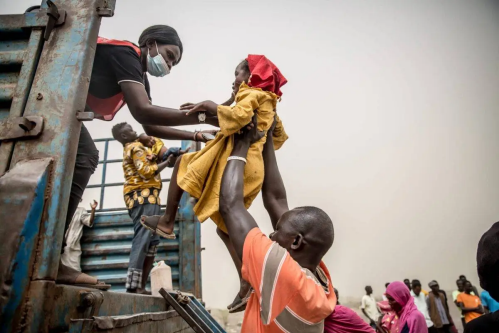
SUDAN WAR RISKS LOST GENERATION OF CHILDREN. Amina’s eyes were red rimmed and vacant, her voice a whisper of grief as she recounted the day her 17-year old son was killed in…Sinja. As gunfire erupted near their home, she tried to escape with her 5 children, but Ahmed was caught in the crossfire. “They shot him in the chest,” placing her hand on her heart as she sat in Kaya refugee camp across the border in So Sudan. “He died in my arms in the middle of the road.” His older brother carried Ahmed’s body to a field, and the family buried the boy in a shallow grave before continuing a 6-day journey to the border. While the world’s attention is fixated on conflicts in the Middle East and Ukraine, a devastating crisis is unfolding in Sudan, where the most vulnerable members of society – children – are bearing the brunt of the violence.
War in Sudan has created the world’s largest child displacement crisis, with 5 million children on the move since the fighting began. Thousands of children like Ahmed have been killed. For those who survive, the future looks bleak. Every day, scores of refugees pour across the border into camps in So Sudan, bringing…harrowing tales of the toll the conflict is taking on children. Famine is wreaking havoc in parts of Sudan, with children facing severe malnutrition. Millions of children have no access to education and healthcare, and many face sexual violence, exploitation and recruitment by armed groups.
Aid agencies grappling to respond are stymied by a lack of foreign aid, restricted access due to intense fighting and the targeting of staff and aid supplies. “Children’s lives…have been utterly torn apart and changed forever, with unimaginable loss, physical and emotional distress and prevalent violations of their rights,” Mohamed Abdiladif, interim Country Dir, Save the Children. “They are hungry, they are scared, they are living a day by-day existence, with stressed and preoccupied parents struggling to meet their needs. A generation isn’t yet lost – but without help, it may well be.”
“…we used to farm sorghum and okra… Life was good in Sudan,” said Jamila, 60, who fled Sennar and made the 7-day trek to So Sudan. Now living in Kaya with her son, daughter and 5 grandchildren, Jamila’s biggest concern was the deteriorating health of her grandchildren. “We are safe here, but life is difficult. There is not enough food. The children cry at night because they are hungry, and they have become thin and weak.” Without treatment, malnutrition can have long-term effects on a child’s health and development. Severe acute malnutrition shuts down children’s immune systems and makes non-life-threatening conditions such as diarrhoea, potentially lethal. It can cause muscle wasting, blurred vision, stunting and organ damage.
Sudan’s war has created one of the worst education crises in the world, with 90% of 19m school-age children unable to access formal education. …schools have been targeted in air strikes, occupied by armed groups and used to store weapons. 2,000 schools – 1 in 10 – are being used to accommodate thousands of displaced families. Fluent in English and passionate about coding, Amir, 17, was a computer science student at college in Khartoum until the conflict forced him to escape…. Now languishing in Kaya Camp, Amir’s days are a stark contrast to his previous life. The camp is remote, and opportunities to learn are scarce. “I feel depressed. Before the war, I had dreams, I had ambitions. I want to study, I want to learn – but there is nothing here for people like me. The war has taken so much from us. My future has been stolen.”
Hundreds of children have been separated from their families due to the fighting, putting them at risk of exploitation, including recruitment by armed groups and sexual violence. UN data shows 1,700 violations of children’s rights in 2023….1,240 cases of killing and maiming children, hundreds of instances of child soldier recruitment and rape and other forms of sexual violence. Armed groups may have been taking some children and
recruiting them. Sometimes, they use children to collect intelligence. “Children are incredibly resilient, and with the right support, they can survive and thrive to become healthy and productive adults,” Save the Children’s Abdiladif. “The world needs to step up now to provide the assistance gravely needed… Without this support, their future is far less certain.”
October 10
INSIDE THE LAST FUNCTIONING HOSPITAL IN KHARTOUM NORTH. Away from the bustling corridors of Bahri Hosp, the only functioning hospital left in Khartoum N, Alsuna Issa sits perched on the edge of a small cot next to her toddler son. The young boy, Jaber, dressed in distressed jeans and a Spiderman t-shirt that grazes his enlarged belly, is malnourished. Due to repeated targeting of healthcare facilities, it is the only hospital left in the city after 100 attacks on health facilities since last year. Issa brought Jaber to the hospital after he suffered fever and diarrhoea for days and she could not find a functioning hospital near her home: “He has been vomiting and his stomach is distended. They tested him and found he has malaria and a stomach infection…but there are no hospitals near me. So I brought him here.” Doctors say hundreds of patients come in daily with needs ranging from surgeries to nutritional care for children. But getting to this hospital is not easy. “We live far away, getting back home is difficult. Sometimes there is fighting or artillery shelling so we have to hide in the nearest house. Sometimes
the hospital is too crowded so we have to come back the next day,” Iqbal Ali. Another patient, Karima Ikram Ahmed Adam: “When someone falls sick…they come carrying them in a wheelbarrow or on a donkey if possible.”
According to Dr Hadeel Malik, Bahri Hosp Emergency Health Dir, the availability of medical resources has been critically low: “The issue of supplies has been a problem since the start of the conflict. That is still the case in areas under the RSF. Sometimes,
medical supplies disappear before reaching our hospitals. We fear for the safety of our workers because the RSF…detained health workers. What we encountered was a lot of devastation, severe destruction and major theft from all the health centres and facilities.” Malik has been part of a team that set up 23 health centres over the past year. For Adam, having community support has been essential to compensate for inadequate healthcare. “By God, if there is someone in our neighbourhood who is sick, everyone, the people
and neighbours, come together and support each other. You can’t manage unless the whole neighbourhood comes together because…the situation is critical. People are just dying and dying, and there has been no aid reaching us until now. I’m pleading for aid to reach us, for medicines to reach us, because the number of sick children is overwhelming.” Al Jazeera
HOW SUDAN’S WAR BECAME A BATTLEGROUND FOR IRAN AND RUSSIA’S RED SEA AMBITIONS. Sudan’s civil war has become another pivotal theatre for geopolitical rivalries as foreign powers compete for influence in the strategically vital
Red Sea region. Sudan’s location offers a chokehold over one of the world’s most crucial maritime trade routes, the Suez Canal, making it a highly coveted target for foreign interests. Iran reportedly offered to set up a naval base in Pt Sudan that would have given Tehran another crucial foothold. Despite the military’s rejection of the offer, there are concerns over Iran’s role in supplying SAF with cutting-edge drone technology and its broader ambitions to monitor maritime activities near Israel and across the region. Russia significantly increased its involvement, offering unrestricted qualitative military aid to Sudan’s government.
Analysts caution that such interventions will likely extend the conflict and disrupt the region’s stability. “Sudan has long been vulnerable to foreign interferences,” Sudanese political analyst Mohamed al-Amin.” After the revolution, several power centres emerged looking to establish control, and foreign powers seized the opportunity to back different factions.”…civilian leaders had been striving to establish a transparent foreign policy to help the country overcome its isolation. Sudan’s military rulers have chosen a different path. SAF and RSF leaders actively sought alliances with foreign actors, including UAE, Egypt, Russia, Iran and Israel to consolidate their hold on power. Sudan has effectively become “a commodity on the global stage,” with each faction exploiting its natural resources, chiefly gold and land, to fund the war. “The Red Sea is now at the centre of intense international competition, and the risk of wider conflict looms large.” Maj Gen Majzoub, a Sudanese military expert, told The New Arab. While Russia and Iran are assisting Sudan with equipment and weapons, direct military intervention is unlikely. “Sudan has become a theatre for regional and international power plays. But establishing foreign military bases remains a precarious move due to Sudan’s unpredictable foreign policy and lack of a coherent strategic direction.”
Iran’s desire for a naval base in Pt Sudan would have allowed Tehran to closely monitor the Suez Canal and Israel’s southern flank. Though the Sudanese military turned down the proposal, Iran has not wholly stepped back, with Majzoub suggesting it is continuing to supply drones to government forces. Suliman Baldo, Exec Dir of Sudan Transparency & Policy Tracker, told The New Arab Iran remains keen on establishing a naval facility in the Red Sea but faces obstacles due to Sudan’s ties with Saudi Arabia. “Sudan’s alignment with Riyadh is a major factor why the base proposal was rejected. But the civil war is providing autocratic regimes with an opening to expand their influence.” Majzoub warned that allowing foreign military bases from non-riparian states could lead to the Red Sea becoming a flashpoint for conflict. “The Red Sea is a vital artery for Gulf oil. If nations like Iran are allowed to establish a military presence, it would be tantamount to a declaration of war.”
According to Baldo, while Russia faces constraints in how much support it can extend to Sudan, it laid significant groundwork in the country. Moscow had already strengthened its foothold in Sudan before the conflict erupted, mainly through Wagner Group.
Wagner mercenaries supported the RSF, supplying military aid and training. “Russia’s involvement in Africa is about leveraging its military capabilities to extract natural resources. Wagner Group evolved into the ‘African Legion,’ operating in failed states like Sudan, offering military and political support in exchange for gold, diamonds, uranium and oil. Russia’s deepening ties with Sudan’s gold industry provided Moscow with a pivotal resource to sidestep Western sanctions. Wagner delivered military trucks, amphibious vehicles and transport helicopters to Sudan, which helped solidify access to gold reserves, a critical resource for Russia’s war effort. “Russia used to be exclusively supportive of the RSF, but the situation has changed, as Moscow supports SAF too. Moscow is offering allegedly unlimited military assistance to Sudan’s Islamist-aligned armed forces led by al-Burhan. He noted that for Iran and Russia to decisively tilt the balance of the conflict, they would need to maintain the supply of advanced drones equipped with night vision and precision-targeting capabilities to the Sudanese army. Majzoub downplayed the likelihood of direct Iranian or Russian military intervention but suggested continued supply of high-grade weaponry could eventually turn the tide in favour of Sudan’s army. “If the military receives high-quality arms, they might achieve a resolution through force….if that happens, we could see other nations respond by backing the RSF, which would only prolong the war.” The New Arab