
Recently, thousands of students spent their Spring Break to
help rebuild New Orleans and the
surrounding Gulf Coast
area. World Can’t Wait was able to speak
to Bryan Ogilvie; a Hampton University student who was involved in defending
the Hampton 7 from expulsion for participating in protests on Nov.2nd and
recently returned from New Orleans after volunteering with the grassroots
organization Katrina on the Ground.
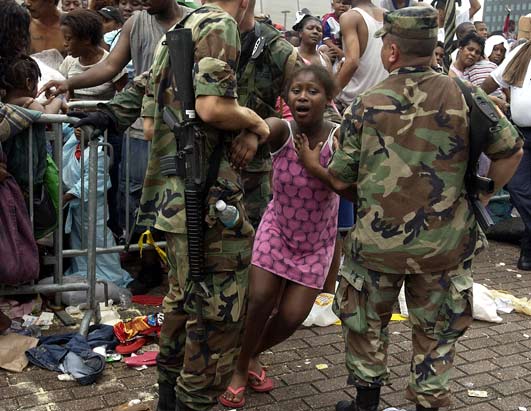
Military tanks patrolling neighborhood streets, martial law
order and people from the slums trapped in Sports Stadiums guarded by police
with automatic rifles. These are not
scenes from a third world country in crisis, but the events that unfolded when
Hurricane Katrina hit New Orleans
this past Fall. Katrina revealed the
true nature of the Bush Regime and concentrated the brutal history for Black
people in this country from Slavery to Jim Crow to the modern police brutality
that terrorizes Black communities.
Despite attempts to silence the outrages that continue in the Gulf Coast
and the miserable conditions Katrina survivors must endure; a growing movement
of people are demanding the government must be held accountable for these
crimes against humanity and rebuild a New Orleans in a way that does not
constitute racial cleansing.
Recently, hundreds traveled to D.C to take part in a march
and rally in support of those who the government abandoned, evacuated, and dispersed
across the country. The marchers went
from the Capitol to the White House demanding that the government immediately
stop its evictions of those who have been displaced from their homes in New
Orleans. This past
January the Bush Crimes Commission heard testimony and was presented evidence
from legal experts, professors and Katrina survivors to determine if the
destruction of New Orleans rose to
the level of crimes against humanity.
The commission found the Bush Administration Guilty and stated:
“The evidence of the Bush Administration’s conscious
and deliberate failings in preventing the foreseeable devastation, including
death toll, caused by Hurricane Katrina, particularly in New
Orleans, and its failure to respond efficiently and
appropriately after the Hurricane was overwhelming. Its failures constitute
crimes against humanity.”
Recently, thousands of students spent their Spring Break to
help rebuild New Orleans and the
surrounding Gulf Coast
area. World Can’t Wait was able to speak
to Bryan Ogilvie; a Hampton University student who was involved in defending
the Hampton 7 from expulsion for participating in protests on Nov.2nd and
recently returned from New Orleans after volunteering with the grassroots
organization Katrina on the Ground.
WCW: What was it like when you first arrived in the city and
your van started to navigate through the streets of New
Orleans?
Bryan: When we first got down there, we drove
through the 9th Ward before we went to the Church we were going to be staying
at. When we first arrived it jolted me
into realizing what time it is and how REAL the whole situation is. Not just with Katrina, but overall in
society. It was shocking to see houses
blown on top of other houses- when you see the frame of a blue and gray house
on top of an orange and red house- and cars upside down) and this was in March,
months after Katrina hit.
WCW: How widespread
and diverse were the students who came to New Orleans?
Bryan: There was
a lot of schools we met people from Spellman, Morehouse, Ithaca,
GeorgiaState
University. My group got that early but there were
students pouring in from around the country when we leaving to go back to
school. I volunteered with students from
different universities doing door- to- door outreach.
WCW: When you were doing door- to ( door outreach, what was
the response students received from local residents?
Bryan: Well I thought that the residents would be
very down and demoralized, but everyone I talked to was really spirited. Many streets are deserted and on a block of
20 houses, maybe 2 of them are occupied.
I learned a lot about New Orleans
itself and many of the people in the 9th Ward talked about the rampant police
brutality. The police brutality that
existed before Katrina was pushed to extremes and one person recounted stories
of the police snatching up drug dealers, taking their drugs and then dropping
them off ten minutes out of the city.
This was common practice in New Orleans.
There are also no real medical clinics or schools, except
privatized charter schools. A majority
of the Black population in New Orleans
know the government does not care about them and wants to eliminate them.
I talked to many people who were trapped in the Superdome
and said it was hell and really did not know if they could make it through that
experience. One resident told me at one
point they found food in the Superdome and began handing it out until the
military confiscated the food.
WCW: What the
relationship between the volunteers and the Federal rebuilding efforts?
Bryan: Well there is a lot going on, but it is all
from the people. The government hasn’t
done a damn thing about rebuilding New Orleans,
everything has come from the people of New Orleans
and volunteers who have come here to help rebuild the city.
WCW: What was the
overall spirit of students coming from all around the country, particularly
Historically Black Colleges, to volunteer in New Orleans?
Bryan: The thing I got from it is) it really went
against all this hoop-la about the failure and apathy of the post- Civil Rights
generation. There have been all of these
attacks saying this generation of Black youth is not making good on the heroic and
historical accomplishments the Civil Rights- era generation achieved. This is an example of why all these attacks
are wrong. Most of the people who
organized these efforts are younger folks who are just out of college.
While the work was intensive there were still a lot of
discussions about what was going on in the world and what Katrina meant given
the history of Black people in America. Katrina is really setting the tone for the
future. If they (Bush Administration)
can do this and get away with it) then you really have to ask what can’t they
do?